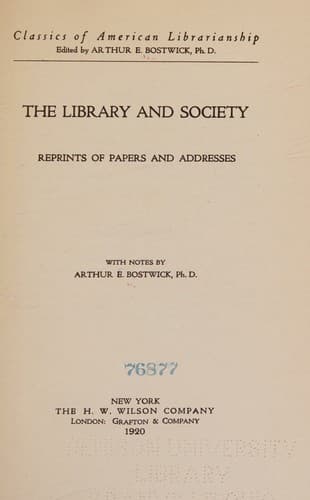
The Library and Society: Reprints of Papers and Addresses
History
The Library and Society: Reprints of Papers and Addresses
Libraries and society; Library science -- Social aspects
Thirdly: Ideals. Our libraries must not be only storehouses of
knowledge, but reservoirs of power. The great books of all time give us
contact with inspiring personalities, shining examples, with the great
leaders of men. The trophies of Themistocles will not suffer us to
sleep. When such books come into many a shut-in life, to many a boyhood,
cabined and confined, the limitations of the farm and factory are
forgotten, the mind expands to a kinship with past and future, and the
reader in some village library may become the prophet of the new
century, and the leader of the modern world.
More than that: the literature of power creates the climate in which we
live. It shapes our ideals of success, of power, of beauty, of goodness.
Fiction and poetry, if they thus create aspiration and give us
standards, may be more useful than all encyclopedias or text-books, for
they deal with the sources and the goal of all human action.
THE PROVISION OF BOOKS
The seven addresses or papers just preceding relate to the
general services of the library to the community. The twelve
that now follow analyze this into four types of special
service, as already suggested--the provision of books, the
collection of information, the control and guidance of
reading and community-centre service. The next three papers
treat of the provision of books.
THE LIBRARIAN AND HIS CONSTITUENTS
That the choice of books is the most important of the
librarian's duties and that "his best effort" should be
given to it, is the thought of an institutional librarian,
R.B. Poole of the New York Y.M.C.A. This view should
interest those who think that administrative problems and
socialization are elbowing the books into the background.
Reuben Brooks Poole was born in Rockport, Mass., in 1834,
and graduated at Brown University in 1857. After serving as
a teacher he became librarian of the Y.M.C.A. library in New
York City, where he remained until his death on April 6,
1895. He was president of his state library association in
1894.
By constituents is not meant political constituents. It is unfortunate
for any librarian when he holds his office in a public library as a
political favor, and library appointments should be as far removed as
possible from all party influences. A public library, like any other
public property, is susceptible of being used as a tool, and may easily
degenerate into a political job, unless specially protected by its
charter. New York city has one such library. The library exists for the
librarians; its constituents--not readers--are of the school of
politics. The example, it is to be hoped, is a unique one in our
country.
A brief retrospect of the libraries and librarians of the past may help
us to more fully comprehend the situation of the librarian and his
constituents of to-day.
Public-domain text, read in full here on John Shaqi.
Reviews
Reviews
No reviews yet
Be the first to share your thoughts on this work.
Elsewhere in the archive
Join the Discussion
Join the discussion
Sign in to leave a comment or review.
Sign InorCreate an account