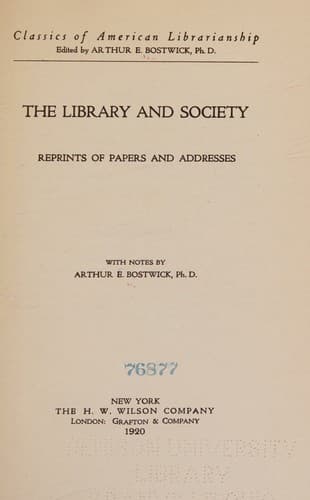
The Library and Society: Reprints of Papers and Addresses
History
The Library and Society: Reprints of Papers and Addresses
Libraries and society; Library science -- Social aspects
The monk represented the librarian of the Middle Ages. He was not by
profession a librarian, and yet the valuable service he rendered to
literature entitles him to the name. He was at once chorister, master of
ceremonies, transcriber, illuminator, and collector. Professedly the
monk was a religious ascetic. He retired from the world to devote
himself to religion, to a life of self-denial. His language was the
Latin; the books or manuscripts that surrounded him were works of the
Fathers, books of devotion, service-books, and the classics. These were
just in keeping with his life and thoughts. A congenial occupation was
thus opened to him. The hours of the cloister were made shorter as the
monk duplicated and reduplicated some dainty missal, or some commentary
of Augustine, or painted a miniature of the Virgin or of the apostles.
However much we may differ in opinion as to the service rendered to
religion by the monasteries of the Middle Ages, as librarians we have a
fellow-feeling with these toiling monks, and are grateful to them for
the service they have rendered the libraries of to-day by their
preservation of works that otherwise would have been destroyed. There is
nothing in the book-making arts of to-day to compare with the artistic
skill displayed in the illuminations and miniature-painting which enrich
and beautify the manuscripts of those times.
The monastic libraries were small, and the readers few. Books were
loaned from monastery to monastery. They were distributed once a year,
at the Lenten season. As each borrower returned his book he was
catechised as to its contents, if the examination was satisfactory he
was allowed another book for the coming year; if not, he must take his
old book again.
One not a member of the order of St. Benedict, or an _attaché_ of Cluny
or Canterbury, could procure the coveted treasure, sometimes, by
pledging to return with the manuscript borrowed a full transcription.
Library economy in these ages was very simple. Catalogues were little
more than inventories, and no discordant notes were chanted, in duets or
solos, over systems of classification. The absolute or fixed system of
shelving was in vogue, the books being held in their places by chains.
The survival of this feature exists in the attachments of the modern
city directory.
But, not to linger longer in cloisters or abbeys, we come to the age of
printing and to the foundation of the modern libraries of Europe; the
treasures in the monastic libraries contributing to form their vast
collections.
Public-domain text, read in full here on John Shaqi.
Reviews
Reviews
No reviews yet
Be the first to share your thoughts on this work.
Elsewhere in the archive
Join the Discussion
Join the discussion
Sign in to leave a comment or review.
Sign InorCreate an account