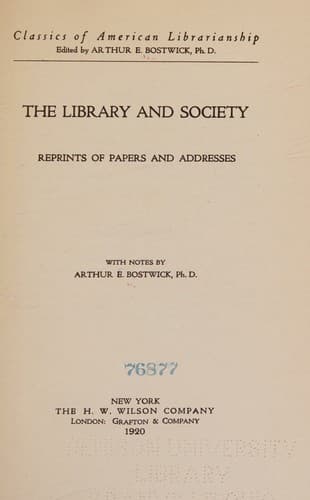
The Library and Society: Reprints of Papers and Addresses
History
The Library and Society: Reprints of Papers and Addresses
Libraries and society; Library science -- Social aspects
A librarian, to be successful, must be a lover of books. The novice, in
applying for a librarianship, often puts it down as one of his cardinal
qualifications that he is fond of reading. To the active, toiling worker
this is not suggestive of business. A love of books very naturally
suggests a taste for reading, except when bibliomania is in the blood. A
true friend of books is not such because his collection embraces
Elzevirs and Aldines, or because they are in Grolier or Bedford
bindings, or printed on Whatman or Holland paper,--these are matters of
just pride,--but because the army of silent authors, marshalled under
his leadership, will diffuse light and knowledge wherever they go. The
librarian imbued with this spirit, if he finds time to read, will
reflect what he has read. It is to be feared that the librarian who
reads in these times is the exception; and yet there can be no question
that, if he could have each day an hour or two for reading,--time enough
to acquaint himself with the thought of the times, and occasionally
commune with the authors of the past,--his efficiency would be greatly
enlarged, and his readers would have a supplemental catalogue in him,
corresponding, to some extent, to the good work contemplated by our
Cooperative Committee.
There are in every library very many books that are what we might term,
to use a mercantile phrase, dead stock. From the very necessities of the
case there must be many books that will be called for only at great
intervals, while others never have a friendly consultation. But, aside
from these, libraries will often have works of great practical value
that are standing idle, because it is not generally known that the
library possesses them. There may be a choice lot of works on
electricity, a rare collection on ceramics, a fine selection of
engravings, representative works in the various industrial arts; the
call for them not being popular and large, they might be brought to the
notice of a larger constituency by calling the attention of certain
readers to them, or by sending a polite invitation to some manufacturing
firms, to some professional electricians, or to art schools and
scientific schools.
Periodicals, before the days of Poole's Index, were sealed books.
Libraries have been wonderfully expanded where this index is used.
Further cooperation in this direction, as planned by the Cooperative
Committee, should receive hearty encouragement. The books of a library
may be further enlarged in their use by publishing, on the library
bulletin, the works in the library that illustrate important events,
after the admirable plan initiated by Mr. Foster, of Providence.
Public-domain text, read in full here on John Shaqi.
Reviews
Reviews
No reviews yet
Be the first to share your thoughts on this work.
Elsewhere in the archive
Join the Discussion
Join the discussion
Sign in to leave a comment or review.
Sign InorCreate an account