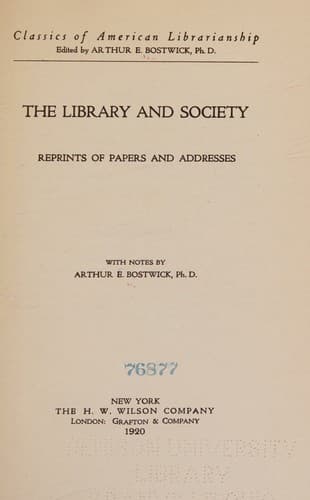
The Library and Society: Reprints of Papers and Addresses
History
The Library and Society: Reprints of Papers and Addresses
Libraries and society; Library science -- Social aspects
available, and a bright, cheerful atmosphere will pervade the alcoves of
his store-house.
The librarian of to-day is developing to the full the utilitarian
principle. He is practical,--practical in his library management,
practical in his choice of books. His constituency is either a
particular class or the great public. To supply the masses with reading,
and to make books helpful in all the vocations of life, is the
librarian's aim. It is just here that we need to emulate our
predecessors, the monks and the collectors and bookworms of the
sixteenth and succeeding centuries.
He must have the spirit of the collector, the animus of the scholar. He
must not forget that he is an antiquarian in his zeal for utility. His
constituency is not confined to the present; he is building for
posterity as well. His library will live after him. He therefore needs
to be a wise master-builder.
If the choice of books is in the librarian's hands, or if he occupies an
important position in connection with the selection, his best effort
should be given to this department. The responsibility is not small. He
will find it more difficult often to reject than to select. He must
consult the wants of his readers; but there is a limit to that.
Everything that is in print may be called for, but that is no reason why
it should be honored with a place in a library. The librarian's personal
equation is not to be the standard, but the foundation principles of
morality, truth, and sound sense must guide him. No quarter should be
given to books of doubtful morality. Fiction now finds a place in most
libraries open to any extent to the public, and this class of books
forms so large a part of the circulation of many libraries that it is
becoming a question of no small importance as to how far public funds
should be expended for such books as afford little else than pastime. A
public library is a public educator. It is not a sluice into which every
publisher may dump his entire wares; as educators, librarians and
managing boards have the right to maintain the purity of their
collections, and to protect them from inundations of worthless books.
The librarian should be alert to supply his readers with all they
require that will be helpful, as we have said; but, more than this, he
should lead them. He may do so by procuring works of standard worth, new
and old, that represent the best thought in any department of literature
or science.
Unless he has something of the spirit of the collector very much will
elude his grasp, and be, perhaps, utterly lost to his library. There are
the limited editions, now so limited in number; the privately printed
book; the first numbers of periodicals; the first reports of societies;
local histories and genealogies; memorial volumes, and the like,--works
whose value is enhanced by time.
Public-domain text, read in full here on John Shaqi.
Reviews
Reviews
No reviews yet
Be the first to share your thoughts on this work.
Elsewhere in the archive
Join the Discussion
Join the discussion
Sign in to leave a comment or review.
Sign InorCreate an account