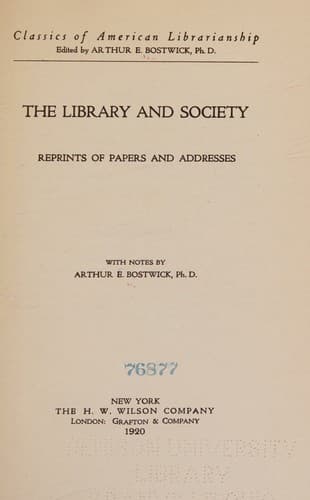
The Library and Society: Reprints of Papers and Addresses
History
The Library and Society: Reprints of Papers and Addresses
Libraries and society; Library science -- Social aspects
The extensive circulation of new and popular works is a
feature of a public library which I have not hitherto much
contemplated. It deserves to be well weighed, and I shall be
happy hereafter to confer with you on the subject. I cannot
deny that my views have, since my younger days, undergone
some change as to the practicability of freely loaning books
at home from large public libraries. Those who have been
connected with the administration of such libraries are apt
to get discouraged, by the loss and damage resulting from
the loan of books. My present impressions are in favor of
making the amplest provision in the library for the use of
books there.
Your plan, however, is intended to apply only to a
particular class of books, and does not contemplate the
unrestrained circulation of those of which the loss could
not be easily replaced.
That Boston must have a great public library, or yield to
New York in letters as well as in commerce, will, I think,
be made quite apparent in a few years. But on this and other
similar subjects I hope to have many opportunities of
conferring with you next winter.
The difference of opinion, here made evident, as to the possibility or
safety of allowing books to circulate freely, was not removed by many
subsequent conversations, nor were the hopes of either of the gentlemen,
with regard to the establishment of a great library, raised even when,
in the early part of 1852, the mayor, Mr. Seaver, recommended that steps
be taken for such an object, and the Common Council, presided over by
Mr. James Lawrence, proposed that a board of trustees for such an
institution should be appointed. When, therefore, both Mr. Everett and
Mr. Ticknor--the latter greatly to his surprise--were invited to become
members of this board, they conferred together anew on the project; and,
although the mayor, on hearing Mr. Ticknor's views, was much pleased
with them, and urged him to take the place, yet he at one time
determined to decline the office, certainly unless the library were to
be open for the free circulation of most of its books, and unless it
were to be dedicated, in the first instance, rather to satisfying the
wants of the less favored classes of the community, than--like all
public libraries then in existence--to satisfying the wants of scholars,
men of science, and cultivated men generally.
THE FUNCTION OF A TOWN LIBRARY
Nearly a quarter-century elapsed after Ticknor's letter,
just quoted, before the publication in book form of Josiah
P. Quincy's "Protection of Majorities and Other Essays"
(Boston, 1875), of which collection his paper on the
function of a town library forms a part. As stated in his
introduction, it appeared originally in _Old and New_, a
magazine already extinct when that introduction was penned.
Public-domain text, read in full here on John Shaqi.
Reviews
Reviews
No reviews yet
Be the first to share your thoughts on this work.
Join the Discussion
Join the discussion
Sign in to leave a comment or review.
Sign InorCreate an account