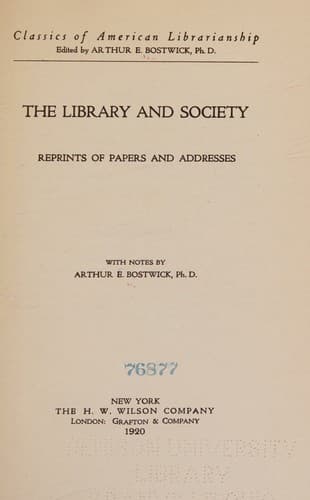
The Library and Society: Reprints of Papers and Addresses
History
The Library and Society: Reprints of Papers and Addresses
Libraries and society; Library science -- Social aspects
Exactly the same type of large library has grown up in America; and
here, too, it is chiefly the universities whose stock of books is at the
service of the scientific world. Besides these, there are special
libraries belonging to learned societies, state law libraries, special
libraries of government bureaus and of museums, and largest of all the
Library of Congress. The collection of such scientific books began at
the earliest colonial period, and at first under theological auspices.
The Calvinist Church, more than any other, inclined to the study of
books. As early as 1790 the catalog of Harvard College contained 350
pages, of which 150 were taken up by theological works. Harvard has
to-day almost a million books, mostly in the department of literature,
philology, history, philosophy, and jurisprudence. There are, moreover,
in Boston the state library of law, with over a hundred thousand
volumes; the Athenaeum, with more than two hundred thousand books; the
large scientific library of the Institute of Technology, and many
others. Similarly, in other large cities, the university libraries are
the nucleus for scientific labors, and are surrounded by admirable
special libraries, particularly in New York, Chicago, and Philadelphia.
Then, too, the small academic towns, like Princeton, Ithaca, New Haven,
and others, have valuable collections of books, which in special
subjects are often unique. For many years the American university
libraries have been the chief purchasers of the special collections left
by deceased European professors. And it often happens, especially
through the gift of grateful alumni, that collections of the greatest
scientific value, which could not be duplicated, come into the
possession even of lesser institutions.
Public-domain text, read in full here on John Shaqi.
Reviews
Reviews
No reviews yet
Be the first to share your thoughts on this work.
Elsewhere in the archive
Join the Discussion
Join the discussion
Sign in to leave a comment or review.
Sign InorCreate an account