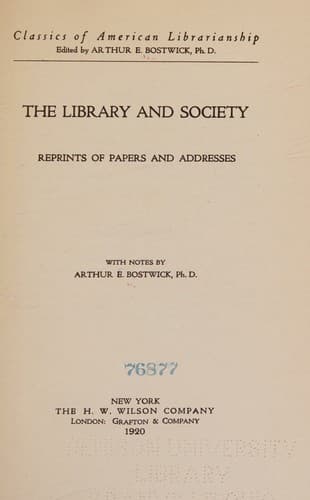
The Library and Society: Reprints of Papers and Addresses
History
The Library and Society: Reprints of Papers and Addresses
Libraries and society; Library science -- Social aspects
In many departments of investigation, Washington takes the lead with
the large collection of the various scientific, economic, and technical
bureaus of the government. The best known of these is the unique medical
library of the War Department. Then there is the Library of Congress,
with many more than a million volumes, which today has an official right
to one copy of every book published in the United States, and so may
claim to be a national library. It is still not comparable to the
many-sided and complete collection of the British Museum; the national
library is one-sided, or at least shows striking gaps. Having started as
the Library of Congress, it has, aside from its one copy of every
American book and the books on natural science belonging to the
Smithsonian Institution, few books except those on politics, history,
political economy, and law. The lack of space for books, which existed
until a few years ago, made it seem inexpedient to spend money for
purposes other than the convenience of congressmen. But the American
people, in its love for books, has now erected such a building as the
world had never before seen devoted to the storing of books. The new
Congressional Library was opened in 1897, and since the stacks have
still room for several million volumes, the library will soon grow to an
all-round completeness like that at London. This Library has a specially
valuable collection of manuscripts and correspondences.
All the collections of books which we have so far mentioned are
virtually like those of Germany. But since they mostly date from the
nineteenth century, the American libraries are more modern, and contain
less dead weight in the way of unused folios. Much more important is
their greatly superior accessibility. Their reading-rooms are more
comfortable and better lighted, their catalogs more convenient, library
hours longer, and, above all, books are more easily and quickly
delivered. Brooks Adams said recently, about the library at Washington
as a place for work, that this building is well-nigh perfect; it is
large, light, convenient, and well provided with attendants. In Paris
and London, one works in dusty, forbidding, and overcrowded rooms, while
here the reading-rooms are numerous, attractive, and comfortable. In the
National Library at Paris, one has to wait an hour for a book; in the
British Museum, half an hour, and in Washington, five minutes. This
rapid service, which makes such a great difference to the student, is
found everywhere in America; and everywhere the books are housed in
buildings which are palatial, although perhaps not so beautiful as the
Washington Library.
Public-domain text, read in full here on John Shaqi.
Reviews
Reviews
No reviews yet
Be the first to share your thoughts on this work.
Elsewhere in the archive
Join the Discussion
Join the discussion
Sign in to leave a comment or review.
Sign InorCreate an account