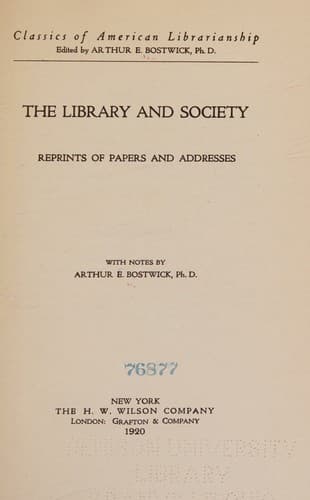
The Library and Society: Reprints of Papers and Addresses
History
The Library and Society: Reprints of Papers and Addresses
Libraries and society; Library science -- Social aspects
"A few years ago my friend, Mr. Alexander Ireland, published a very
interesting volume which he called "The book-lover's euchiridion," the
handbook, that is to say, of those who love books. It was made up of
extracts from the writings of a great variety of distinguished men,
ancient and modern, in praise of books. It was a chorus of many voices
in many tongues, a hymn of gratitude and praise, full of such piety and
fervor as can be parelleled only in songs dedicated to the supreme
power, the supreme wisdom and the supreme love. Nay, there is a glow of
enthusiasm and sincerity in it which is often painfully wanting in those
other too commonly mechanical compositions. We feel at once that here it
is out of the fulness of the heart, yes, and of the head, too, that the
mouth speaketh. Here was none of that compulsory commonplace which is
wont to characterize those 'testimonials of celebrated authors,' by
means of which publishers sometimes strive to linger out the passages of
a hopeless book toward its _requiescat_ in oblivion. These utterances
which Mr. Ireland has gathered lovingly together are stamped with that
spontaneousness which is the mint mark of all sterling speech. It is
true that they are mostly, as is only natural, the utterances of
literary men, and there is a well-founded proverbial distrust of herring
that bear only the brand of the packer, and not that of the sworn
inspector. But to this objection a cynic might answer with the question,
'Are authors so prone, then, to praise the works of other people that we
are to doubt them when they do it un-asked?' Perhaps the wisest thing I
could have done to-night would have been to put upon the stand some of
the more weighty of this cloud of witnesses. But since your invitation
implied that I should myself say something, I will endeavor to set
before you a few of the commonplaces of the occasion, as they may be
modified by passing through my own mind, or by having made themselves
felt in my own experience.
The greater part of Mr. Ireland's witnesses testify to the comfort and
consolation they owe to books, to the refuge they have found in them
from sorrow or misfortune, to their friendship, never estranged and
outliving all others. This testimony they volunteered. Had they been
asked, they would have borne evidence as willingly to the higher and
more general uses of books in their service to the commonwealth, as well
as to the individual man. Consider, for example, how a single page of
Burke may emancipate the young student of politics from narrow views and
merely contemporaneous judgments. Our English ancestors, with that
common-sense which is one of the most useful, though not one of the most
engaging, properties of the race, made a rhyming proverb, which says
that:
"When land and goods are gone and spent,
Then learning is most excellent";
Public-domain text, read in full here on John Shaqi.
Reviews
Reviews
No reviews yet
Be the first to share your thoughts on this work.
Elsewhere in the archive
Join the Discussion
Join the discussion
Sign in to leave a comment or review.
Sign InorCreate an account