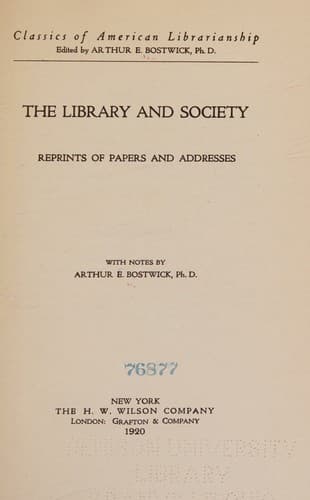
The Library and Society: Reprints of Papers and Addresses
History
The Library and Society: Reprints of Papers and Addresses
Libraries and society; Library science -- Social aspects
and this is true, so far as it goes, though it goes, perhaps, hardly
far enough. The law also calls only the earth and what is immovably
attached to it _real_ property, but I am of opinion that those only are
real possessions which abide with a man after he has been stripped of
those others falsely so called, and which alone save him from seeming
and from being the miserable forked radish to which the bitter scorn of
Lear degraded every child of Adam. The riches of scholarship, the
benignities of literature, defy fortune and outlive calamity. They are
beyond the reach of thief or moth or rust. As they cannot be inherited,
so they cannot be alienated. But they may be shared, they may be
distributed, and it is the object and office of a free public library to
perform these beneficial functions.
"Books," says Wordsworth, "are a real world," and he was thinking,
doubtless, of such books as are not merely the triumphs of pure
intellect, however supreme, but of those in which intellect infused with
the sense of beauty aims rather to produce delight than conviction, or,
if conviction, then through intuition rather than formal logic, and,
leaving what Donne wisely calls
"Unconscious things, matters of fact,"
to science and the understanding, seeks to give ideal expression to the
abiding realities of the spiritual world for which the outward and
visible world serves at best but as the husk and symbol. Am I wrong in
using the word _realities_?--wrong in insisting on the distinction
between the real and the actual? in assuming for the ideal an existence
as absolute and self-subsistent as that which appeals to our
senses--nay, so often cheats them in the matter of fact? How very small
a part of the world we truly live in is represented by what speaks to us
through the senses when compared with that vast realm of the mind which
is peopled by memory and imagination, and with such shining inhabitants!
These walls, these faces, what are they in comparison with the countless
images, the innumerable population which every one of us can summon up
to the tiny show-box of the brain, in material breadth scarce a span,
yet infinite as space and time? And in what, I pray, are those we
gravely call historical characters, of which each new historian strains
his neck to get a new and different view, in any sense more real than
the personages of fiction? Do not serious and earnest men discuss Hamlet
as they would Cromwell or Lincoln? Does Cæsar, does Alaric, hold
existence by any other or stronger tenure than the Christian of Bunyan
or the Don Quixote of Cervantes or the Antigone of Sophocles? Is not the
history which is luminous because of an indwelling and perennial truth
to nature, because of that light which never was on land or sea, really
_more_ true, in the highest sense, than many a weary chronicle with
names, date, and place in which "an Amurath to Amurath succeeds"? Do we
know as much of any authentic Danish prince as of Hamlet?
Public-domain text, read in full here on John Shaqi.
Reviews
Reviews
No reviews yet
Be the first to share your thoughts on this work.
Elsewhere in the archive
Join the Discussion
Join the discussion
Sign in to leave a comment or review.
Sign InorCreate an account