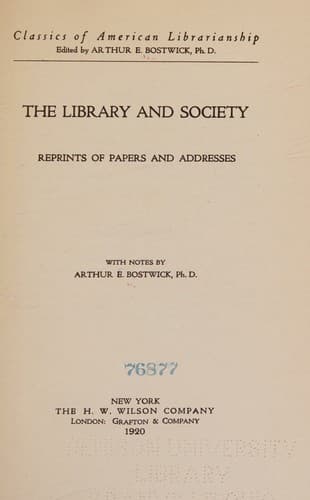
The Library and Society: Reprints of Papers and Addresses
History
The Library and Society: Reprints of Papers and Addresses
Libraries and society; Library science -- Social aspects
One is sometimes asked by young people to recommend a course of
reading. My advice would be that they should confine themselves to the
supreme books in whatever literature, or still better to choose some one
great author, and make themselves thoroughly familiar with him. For, as
all roads lead to Rome, so do they likewise lead away from it, and you
will find that, in order to understand perfectly and weigh exactly any
vital piece of literature, you will be gradually and pleasantly
persuaded to excursions and explorations of which you little dreamed
when you began, and will find yourselves scholars before you are aware.
For remember that there is nothing less profitable than scholarship for
the mere sake of scholarship, nor anything more wearisome in the
attainment. But the moment you have a definite aim attention is
quickened, the mother of memory, and all that you acquire groups and
arranges itself in an order that is lucid, because everywhere and always
it is in intelligent relation to a central object of constant and
growing interest. This method also forces upon us the necessity of
thinking, which is, after all, the highest result of all education. For
what we want is not learning, but knowledge--that is, the power to make
learning answer its true end as a quickener of intelligence and a
widener of our intellectual sympathies. I do not mean to say that every
one is fitted by nature or inclination for a definite course of study,
or indeed for serious study in any sense. I am quite willing that these
should 'browse in a library,' as Dr. Johnson called it, 'to their
hearts' content. It is, perhaps, the only way in which time may be
profitably wasted. But desultory reading will not make a "full man," as
Bacon understood it, of one who has not Johnson's memory, his power of
assimilation, and, above all, his comprehensive view of the relations of
things. "Read not," says Lord Bacon, in his "Essay of Studies," "to
contradict and confute; nor to believe and take for granted; nor to find
talk and discourse; but to weigh and consider. Some books are to be
tasted, others to be swallowed, and some few to be chewed and
digested--that is, some books are to be read only in parts; others to be
read, but not curiously (carefully), and some few to be read wholly and
with diligence and attention. _Some books also may be read by deputy._"
This is weighty and well said, and I would call your attention
especially to the wise words with which the passage closes.
Public-domain text, read in full here on John Shaqi.
Reviews
Reviews
No reviews yet
Be the first to share your thoughts on this work.
Elsewhere in the archive
Join the Discussion
Join the discussion
Sign in to leave a comment or review.
Sign InorCreate an account