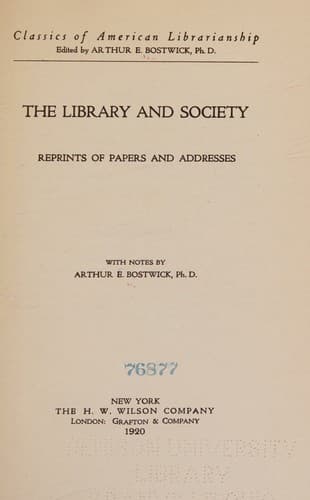
The Library and Society: Reprints of Papers and Addresses
History
The Library and Society: Reprints of Papers and Addresses
Libraries and society; Library science -- Social aspects
I have been speaking of such books as should be chosen for profitable
reading. A public library, of course, must be far wider in its scope. It
should contain something for all tastes, as well as the material for a
thorough grounding in all branches of knowledge. It should be rich in
books of reference, in encyclopædias, where one may learn without cost
of research what things are generally known. For it is far more useful
to know these than to know those that are _not_ generally known. Not to
know them is the defect of those half trained and therefore hasty men
who find a mare's nest on every branch of the tree of knowledge. A
library should contain ample stores of history, which, if it do not
always deserve the pompous title which Bolingbroke gave it, of
philosophy teaching by example, certainly teaches many things profitable
for us to know and lay to heart; teaches among other things how much of
the present is still held in mortmain by the past; teaches that, if
there be no controlling purpose, there is, at least, a sternly logical
sequence in human affairs, and that chance has but a trifling dominion
over them; teaches why things are and must be so and not otherwise;
teaches, perhaps, more than anything else, the value of personal
character as a chief factor in what used to be called destiny, for that
cause is strong which has not a multitude but one strong man behind it.
History is indeed mainly the biography of a few imperial men, and forces
home upon us the useful lesson how infinitesimally important our own
private affairs are to the universe in general. History is clarified
experience, and yet how little do men profit by it--nay, how should we
expect it of those who so seldom are taught anything by their own!
Delusions, especially economical delusions, seem the only things that
have any chance of an earthly immortality. I would have plenty of
biography. It is no insignificant fact that eminent men have always
loved their Plutarch, since example, whether for emulation or avoidance,
is never so poignant as when presented to us in a striking personality.
Autobiographies are also instructive reading to the student of human
nature, though generally written by men who were more interesting to
themselves than to their fellow-men. I have been told that Emerson and
George Eliot agreed in thinking Rousseau's "Confessions" the most
interesting book they had ever read.
A public library should also have many and full shelves of political
economy, for the dismal science, as Carlyle called it, if it prove
nothing else, will go far toward proving that theory is the bird in the
bush, though she sing more sweetly than the nightingale, and that the
millennium will not hasten its coming in deference to the most
convincing string of resolutions that were ever unanimously adopted in
public meeting. It likewise induces in us a profound distrust of social
panaceas.
Public-domain text, read in full here on John Shaqi.
Reviews
Reviews
No reviews yet
Be the first to share your thoughts on this work.
Elsewhere in the archive
Join the Discussion
Join the discussion
Sign in to leave a comment or review.
Sign InorCreate an account