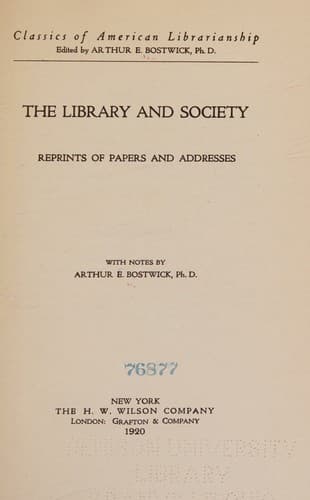
The Library and Society: Reprints of Papers and Addresses
History
The Library and Society: Reprints of Papers and Addresses
Libraries and society; Library science -- Social aspects
In 1850 the total attendance on colleges in the United States was about
ten thousand. Half a century later, when the population of the country
had increased about three and one-third times, the college students had
increased in a tenfold ratio, or more than three times as rapidly as the
population. Even more significant is the growth of the number of college
students in more recent years. Since 1889 the number has more than
doubled, thus continuing in the latest years a ratio of growth with
reference to population quite as great as in earlier years.
An equally significant, and quite as conspicuous change, is seen in the
growth of technical education. Thirty years ago, when I came to
Wisconsin, the university was graduating from two or three and a half
dozen engineers yearly, and these could not all find occupation in this
commonwealth, with a population then of more than a million people. Now
a hundred graduates go out at Commencement, while the population of the
state has little more than doubled, and while other engineering schools
of high rank have multiplied all around it.
Nowadays the man of books, rather than the man of tradition is directing
the work of the world. In the copper mines of the north the
old-fashioned mine captain, who received his profession and his
traditions from his father, is disappearing and has almost vanished. His
place is taken by the graduate of a mining school, who interprets what
he sees, not by the light of the experience of his elders, communicated
to him orally, but by the far clearer light of the collective experience
of men embodied in books.
When the capitalist now desires to explore for new iron mines he employs
not the old-fashioned prospector, but puts into the field a party of
young men often fresh from the geological laboratory. Thus science,
organized knowledge, book learning, is driving out with increasing
rapidity the picturesque figures of past times--times wholly past,
though only just behind us in years. That "bookish theoric," so detested
by Iago, is apparently firmly in control of affairs and has displaced
its predecessors and rivals.
Public-domain text, read in full here on John Shaqi.
Reviews
Reviews
No reviews yet
Be the first to share your thoughts on this work.
Elsewhere in the archive
Join the Discussion
Join the discussion
Sign in to leave a comment or review.
Sign InorCreate an account