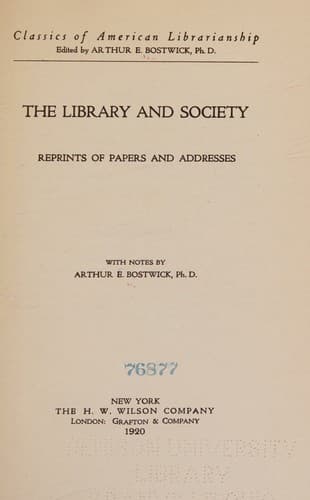
The Library and Society: Reprints of Papers and Addresses
History
The Library and Society: Reprints of Papers and Addresses
Libraries and society; Library science -- Social aspects
In countless other ways the same fact is shown. Half a century ago a
youth who desired to become a lawyer or a doctor entered the office of a
practitioner and learned his profession by practise and experience. Now
he goes to the school of law or medicine and gains his entrance to his
chosen calling by the way of books and laboratories. Even commerce and
trade, in which the rules of practical experience seem most firmly
entrenched, are shifting their basis to books, and schools of commerce
and trade schools are springing up on every hand to give youth a broader
foundation of knowledge than can be gained from practise. Still more
significant are the facts shown by the enormous development of
agricultural experiment stations, farmers' bulletins and farmers'
institutes. Agriculture, that calling which of all others is most
ancient and most conservative, is rapidly changing its basis from
tradition to books. Perhaps I ought not to say "most conservative," for
there is one calling which may better deserve the title--that of the
domestic industries practised by women. Yet even here a beginning of the
transfer, although a small one, has been made by schools of domestic
science.
While this beginning is but small, and while the traditional professions
of women have not yet been greatly modified by books, the life of no
class of the community has been more profoundly affected by this general
change than has that of women. With the passing away of home industries
and with the great increase of wealth which the past century, or half
century, has seen, have come vastly increased opportunities to women for
leisure, for release from domestic duties, and for the prolongation of
school life. The statistics of high schools and colleges sufficiently
show the use which they are making of this leisure. Other facts are
equally obvious and significant as showing the transfer of the basis of
woman's life from domestic experience to books. The woman's club, I
suppose, may be said fairly to take the place of the sewing circle of
our mothers and grandmothers. The contrast even in the name is
significant, as marking the transfer of interest from the circle of
domestic experience to the wider domain of the recorded life of the
world, to the realm of books.
Thus at whatever point we examine the life of the present, we find it
basing itself on books, both for action and enjoyment, and that in an
ever-increasing degree. This truth is peculiarly evident to you as
librarians, since the facts of your own profession and the rapid growth
of libraries and library work afford one of the latest phases of this
general movement.
Public-domain text, read in full here on John Shaqi.
Reviews
Reviews
No reviews yet
Be the first to share your thoughts on this work.
Elsewhere in the archive
Join the Discussion
Join the discussion
Sign in to leave a comment or review.
Sign InorCreate an account