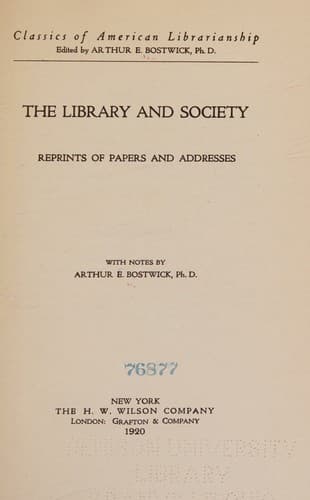
The Library and Society: Reprints of Papers and Addresses
History
The Library and Society: Reprints of Papers and Addresses
Libraries and society; Library science -- Social aspects
This change marks a fundamental departure of the library from its old
basis, and one which will affect it greatly, for good and perhaps for
ill. The movement toward freedom of administration was really concerned
with small matters, and left unaltered the central plan and purpose of
the library. But with the assumption of direct educational work for
children, for women, for men, the library has entered upon a new epoch
in its evolution. It has taken up duties whose performance will demand
greatly enlarged resources--of space and of money, of books and of
working staff. And what is of even greater importance, the purpose, the
point of view, of those who control the library, and the temper of the
administration, will change, and ought to change, under the pressure of
these new duties.
This positive and educational library work falls into two main
types--that for children, and that for adults--both men and women. It is
still in a tentative condition, in a formative and experimental period.
The results are still so few and recent that they do not admit any exact
formulation. They permit only general and suggestive statement.
Work for children is, in some ways, the easiest educational attempt of
the library, since it runs parallel to the work of the schools, and
those for whom the work is done are easily reached and easily guided.
Its function is, of course, in part to supplement the school. It would
be, however, a great misfortune if it were looked upon merely as a
supplement to the school, as a means of providing reading which the
school ought to buy, but cannot afford. Its purpose is rather to begin
in childhood, both for pleasure and for profit, a voluntary association
with books which lie wholly outside of the school program. It aims to
begin the early formation of the habit of reading as distinguished from
study--a habit which will be permanent, instead of ending with the
period of formal instruction. It recognizes the fact that school life
must soon end, and that when the end comes, the important feature of the
child's intellectual condition is not so much the amount he has learned
as the temper and habit of his mind toward books. Has he merely learned
certain truths from books or are books open to him? It is of fundamental
importance to the community that the second alternative be secured. The
school libraries and children's librarians are, therefore, not to feel
that their duty is to supplement the school. That duty lies on a
different, and, in a way, a higher plane, in a more spiritual region. It
is their part to make the child a citizen of the world of books, and to
naturalize him so thoroughly that he will always remain a citizen. Thus
only can he share fully, not only in the high and permanent pleasures
that books afford, but also in that great movement of life toward books
which marks our time.
Public-domain text, read in full here on John Shaqi.
Reviews
Reviews
No reviews yet
Be the first to share your thoughts on this work.
Elsewhere in the archive
Join the Discussion
Join the discussion
Sign in to leave a comment or review.
Sign InorCreate an account