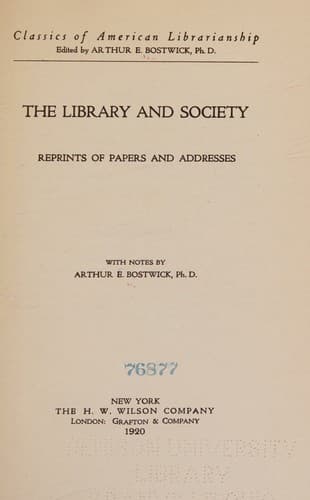
The Library and Society: Reprints of Papers and Addresses
History
The Library and Society: Reprints of Papers and Addresses
Libraries and society; Library science -- Social aspects
From 1875 to 1896 the number of libraries in the United States just
about doubled, increasing steadily, and adding, during this period,
about 2,000 libraries, or a little less than 100 per year. From 1896 to
1900, 1,350 libraries were added, or about 450 per year. From 1900 to
1903, 1,500 libraries were founded, or 500 per year. In the past ten
years the number of libraries must have doubled; a ratio growth at least
four times that of the population....
It is plain that the adjustment of the library to this movement of
men's minds towards books is the most important practical question for
all of us. Questions of management, of administration, of methods are
all of secondary importance beside this one--if, indeed they may be
called even secondary. For this change of base is a revolutionary
affair, not a mere matter of readjustment of detail, and it is no easy
task for the library to find itself in such a movement. Libraries are so
small a part of the national intellectual life, so small, in the mass,
for example, in comparison to the great universities, that their proper
influence and work are easily overlooked. There is sometimes danger that
they may be swept into currents guided by other forces rather than find
opportunity freely to contribute their own share to the movement.
Let us turn then to the more practical side of the question, and ask how
the library is adjusting itself, in this changed relation of men, where
it has best succeeded, and where it still has most to do. Let us ask
where experience seems to promise successful solution of problems, and
where the problems are in that stage in which only doubtful success can
be expected from experiments, and final solution still lies far before
us.
The library began as a place to keep books, permitting their use by the
public, but often under such restrictions as seem to indicate that this
service was granted "grudgingly and of necessity." Books and the high
life were in some obscure way correlated in the mind of the librarian,
and he too often seemed to feel that these were treasures not to be
shared by the many. The first change which came, therefore, as the
library was swept into the general intellectual current of time, was the
removal of restrictions on the use of books and their replacement by
devices intended to encourage and extend that use. A second step, and a
much more revolutionary one, has been to teach the community directly
the uses of books, and thus not merely to afford easy conditions for the
use of books on the part of those who want them, but to add a positive
force which will compel the books to go out in the community, there to
perform their present service and to create a demand for an increased
service in the future.
Public-domain text, read in full here on John Shaqi.
Reviews
Reviews
No reviews yet
Be the first to share your thoughts on this work.
Elsewhere in the archive
Join the Discussion
Join the discussion
Sign in to leave a comment or review.
Sign InorCreate an account