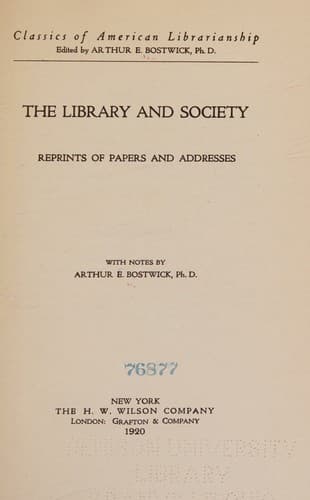
The Library and Society: Reprints of Papers and Addresses
History
The Library and Society: Reprints of Papers and Addresses
Libraries and society; Library science -- Social aspects
The library's influence over women has been the greatest in extent and
productive of the largest results; so much so that, in the opinion of
many critics of the public library, that institution is in danger of
becoming "feminized." I shall not attempt to discuss so large a subject
as that indicated by this fearful word, but it may not be unprofitable
to touch upon the causes which have given the work of the library for
women at once so great an extension and so great a success, as well as
some obvious limitations. I should place first among the causes, both
for the success and the limitation of this influence, the recent
acquisition by women of large opportunities for the intellectual life,
their natural conservatism, and their greatly increased leisure as
compared with men. That women read books, and read them in enormous
numbers, is granted, indeed asserted. That they read seriously I have
heard questioned and have always wondered at the doubt. It seems to me
rather that they never read in any way except seriously. How many
women--reading women, I mean--can put away an unfinished book without a
sense of guilt? How many can "browse about" in a library and enjoy doing
so? How many really like to read a dictionary or encyclopaedia without
ulterior designs upon an article for the women's club, or, at least,
without wanting to know something? These are all tests--unconscious, but
none the less excellent--of the real readers, of those to whom books are
alive and intimate friends. While I have no statistics at hand, I fear
that many women most devoted to libraries would fail to reach this
standard. The field of the intellectual life has been widely opened to
women so recently that they still feel a certain sense of duty along
with the privilege which is granted them in entering it, rather than a
complete sense of being at home there. The conservatism of women helps
this tendency to read seriously and for general purposes. The
traditional use of books as a means of culture appeals to their more
conservative mind as it does not to men. They are more easily induced to
read for reading's sake--they are willing to read the books one ought to
read. They are moved by considerations of mental improvement independent
of any result beyond the improvement itself. The library as a library
attracts them. Then, too, the amount of their reading and its character
is modified by the fact that women are so much more limited than men in
means to pass their leisure. Jerome K. Jerome (if correctly reported by
newspapers) recently pointed out that much so-called reading is no more
an intellectual process than is smoking a cigar, and that often we go to
books just as to the cigar, to pass the time and to prevent the
intrusion of disagreeable thoughts. Of course this is, and ought to be,
wholly true, and since with us the cigar is a masculine privilege, the
woman must take to books as the man takes to smoking, and even to
drinking.
Public-domain text, read in full here on John Shaqi.
Reviews
Reviews
No reviews yet
Be the first to share your thoughts on this work.
Elsewhere in the archive
Join the Discussion
Join the discussion
Sign in to leave a comment or review.
Sign InorCreate an account