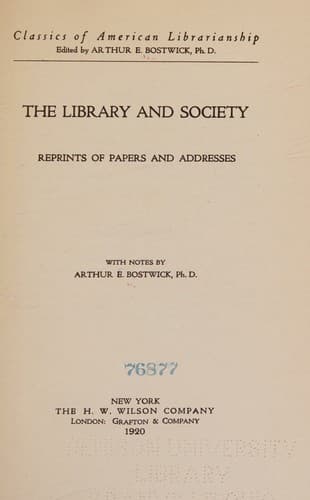
The Library and Society: Reprints of Papers and Addresses
History
The Library and Society: Reprints of Papers and Addresses
Libraries and society; Library science -- Social aspects
Speaking seriously, the library is to many women a relief from
care--the only distraction from the monotony of routine. It is a cheap
and easy thing to sneer at this use of books, but we who believe in the
friendship of books know that here lies one of the greatest blessings
they can give, as it is one of the greatest blessings of true
friendship. Nor do we wonder that the uncultivated, or the
half-cultivated, often choose their book friends from a class not
greatly above their own.
On the other hand, women have hardly begun to use books on lines along
which we are seeking to get men to read--in directions connected with
their trade or profession. Domestic industries, so far as they are in
the hands of women, are still most wholly dependent upon tradition. They
are not exposed to competition. Failure or inefficiency does not put the
proprietor out of business. Their results are not measured in dollars
and cents. In a word, the whole line of motives which is forcing
masculine industries over to the basis of books is lacking in the chief
feminine occupations. We are now seeing only the feeble beginnings of
the attempt thus to transfer them from tradition to science. A long time
must pass, and social conditions greatly change, before the transfer is
made. Thus women are not forced from general to special lines of
reading, while they have greater motive for general reading than have
men.
As a result, women are becoming, to a degree without example in the
past, the possessors and transmitters of the life of culture. I do not
believe that fewer men read good literature than formerly, but the
increase in masculine readers of this type has been so much less than
the increase in women readers that in comparison the number of men seems
to have shrunken greatly. Of course much of this reading by women for
culture is desultory and aimless, much is misdirected. But after all
deductions are made, it remains true that the knowledge of books seems
to be tending to become the possession of women rather than of men. It
has always belonged to a certain class of men--not a very large part of
the community--and it is still theirs; but its extension to other
classes has been along female lines rather than male, and its
transmission to the next generation seems only too likely to depend in a
large measure upon the female line. College statistics at present show
the same facts. Language, literature, and art are the chosen studies of
women. Men turn rather to science, economics, or politics--subjects
which, they suppose, bear directly on future plans for life. These great
subjects whose main purpose in education is the uplifting of the mind,
the widening of the mental horizon without direct reference to any
specific line of life--these appeal far more strongly to women than to
men, and their influence, in a rapidly increasing degree, will reach the
next generation through the mother rather than through the father. It
Public-domain text, read in full here on John Shaqi.
Reviews
Reviews
No reviews yet
Be the first to share your thoughts on this work.
Elsewhere in the archive
Join the Discussion
Join the discussion
Sign in to leave a comment or review.
Sign InorCreate an account