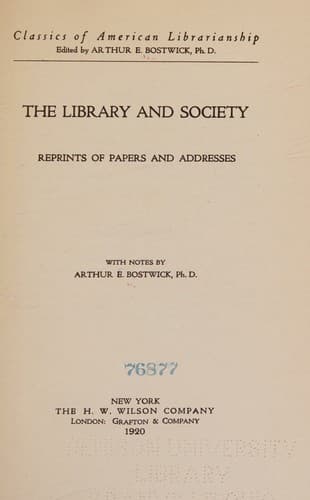
The Library and Society: Reprints of Papers and Addresses
History
The Library and Society: Reprints of Papers and Addresses
Libraries and society; Library science -- Social aspects
would be a pessimistic view which would say that modern society is
coming to depend on the mothers for the accumulation and transmission of
culture, while retaining in the male line the function of accumulating
and transmitting wealth, though much could be said for the thesis and a
very plausible argument could be constructed for it.
If all this is true, it is inevitable that women should use libraries
far more than men. It is equally inevitable that in this large use much
should be trivial, much customary, much misdirected and unwise. Nature
has no means of reaching success except by the rule of natural
selection--the old-fashioned plan of "cut-and-try," and this means much
failure along the road of advance. We who see the work of the library
from our daily experience know how much it is contributing of culture,
how much of happiness, to the life of women, and through them to that of
the community.
But men--why do they not use the library, say the critics, and what
shall the library do to increase its use by men? You have all read the
vigorous article that the _Independent_ published on this subject last
summer, which, with much of error, contains a good deal of truth in a
stimulating form. It presents a subject which must have a somewhat
larger treatment.
It ought first to be said that in this and other articles on the topic
the terms _women_ and _men_ are by no means similarly used. The writers
are not concerned about men at large--the husbands and brothers of the
women who are said to visit the library--the women of comparative
leisure, who are seeking information on art, literature, or ancestry,
who are trying to get up a paper for the club, or who visit the library
for recreation. It is the plumber, the machinist, the grocer, whose
absence they deplore, and to whom they think the library ought to give
help. Not only so, but it is the plumber, rather than as a man, whose
presence is desired and who is to be aided. The library, says the
_Independent_ in effect, ought to teach the plumber how to "plumb";
ought to furnish him with information which his boss is unable to give.
But this is a new function for libraries, however useful it may be, and
a function which libraries do not attempt for women. Dressmakers do not
(I speak under correction, but I think I am right) expect to secure at a
library a knowledge of how to fit a difficult customer, any more than do
tailors. Yet this sort of thing, we are told, the library ought to do
for men; and we are told in a tone which implies that here is an obvious
duty which only wilful ignorance can overlook.
Public-domain text, read in full here on John Shaqi.
Reviews
Reviews
No reviews yet
Be the first to share your thoughts on this work.
Elsewhere in the archive
Join the Discussion
Join the discussion
Sign in to leave a comment or review.
Sign InorCreate an account