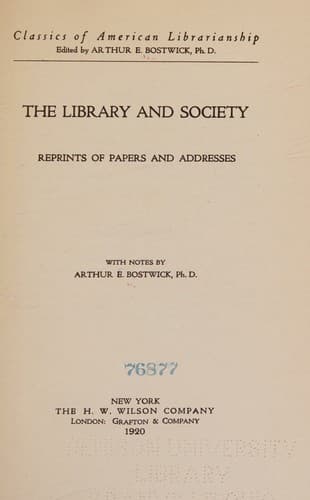
The Library and Society: Reprints of Papers and Addresses
History
The Library and Society: Reprints of Papers and Addresses
Libraries and society; Library science -- Social aspects
The library, therefore, should not enter upon these duties blindly or
ignorantly. It is a great task which is thus undertaken--to educate the
community to use books and to guide it in that use. Although small
beginnings are possible, the work will inevitably grow on our hands just
as that of the schools and colleges has done, and for similar reasons.
But whatever difficulties lie in the way of their performance, it is
plain that the library must assume these new duties. With many
experiments, with many failures, with many partial successes, the
library will extend its teachings, its conscious influences, until they
touch the life of the community at every point.
In this rambling talk I have discussed library work as it looks forward
to new problems, and have devoted only a word, and that perhaps a rather
disparaging one, to the traditional use of the library. I would not
leave the subject in this way. For the traditional use of books remains
and will remain the center of library work and the main source of its
best influences. The problem of the library to-day, looked at from
within and not from without, and in relation to other agencies, is
essentially that which confronts the university. Both institutions once
stood for culture and for culture exclusively. Both are now challenged
by the spirit of the newer time and are called upon to justify
themselves as public utilities. This they must do, and that in full
measure, but there is a real danger that both, in the multiplicity of
the new duties thus forced upon them, may forget the weighty words,
"these ought ye to do and not leave the other undone." For, after all,
the highest public utility which the library offers, or can offer, is
the opportunity to cultivate the friendship of books. This utility is
none the less precious because it is intangible. Indeed, it is the
unique privilege of the library among municipal enterprises that it can
provide a service which aids the higher life of the citizen so directly
and so purely. In the spirituality of this function, the library stands
second only to the highest institutions of pure learning, and to the
church.
No new undertaking, no extension of work, no plea of necessity can
warrant or justify any loss of power on this highest level. The problem
is not to discover how to sacrifice as little as possible of the old
spirit to the new duties, but to learn how through the new duties we may
make more wide-spread and more potent for good that oldest and best
inheritance from the past--the love of books.
Public-domain text, read in full here on John Shaqi.
Reviews
Reviews
No reviews yet
Be the first to share your thoughts on this work.
Elsewhere in the archive
Join the Discussion
Join the discussion
Sign in to leave a comment or review.
Sign InorCreate an account