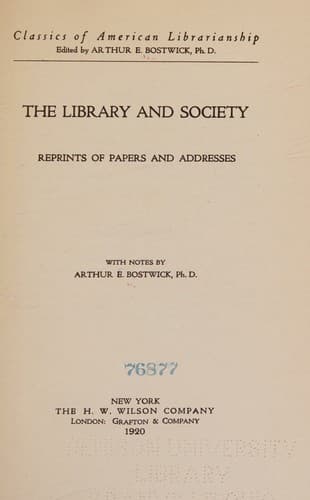
The Library and Society: Reprints of Papers and Addresses
History
The Library and Society: Reprints of Papers and Addresses
Libraries and society; Library science -- Social aspects
"The people's university," the library has been called, but it would be
as great a pity if the librarian so understood this term as to believe
that people came to the library only to learn, as it would be if any
went there who could not learn what they sought. That university which
is a place to study rather than a place to live is missing its best
possibilities, and in a similar way the library ought to be, first and
always, a place to read rather than a place to study. I would not go so
far as to say that I want to find it a place to "loaf," though I might
be provoked into saying so; but certainly it must be a place where I can
"invite my soul"--such a place as the world gives me elsewhere only in
the church or in the silence of nature. Trade journals and technical
works are of great use; books for women's clubs are good things; the
children's room is a necessity; but these of themselves no more make a
library than a kitchen, dining room and bedroom make a home. Out of such
utilities as these you may get a boarding house, but nothing better; the
family makes it a home. Those are wholly wrong who believe that standard
books are so cheap that anyone can buy them, and therefore the library
could conceivably get on without them. Without the best literature you
might get a very useful institution, no doubt, but not a library, for in
a library the great works of the great authors are the soul and theirs
is the spirit which enables the library not merely to contribute to the
advance of the community toward prosperity and intelligence, but also,
in some degree, to touch its higher life to finer issues.
THE BOSTON PUBLIC LIBRARY
AN ADDRESS AT ITS DEDICATION
This and the four addresses that follow it have little in
common except that all were delivered at the opening
exercises of libraries. Everett's address at the opening of
the Boston Public Library appropriately heads the group. The
reader will look in it in vain for any reflection of the
conservative opinions expressed in the letter to George
Ticknor printed on page 53 of this volume, unless perhaps in
the total absence of anything radical. It is typical oratory
of the day--ponderously graceful, if that is not a
contradiction in terms.
Edward Everett was born in Dorchester, Mass., April 11,
1794. He graduated at Harvard in 1811 and served there as
professor of Greek in 1819-25. He was a member of Congress
in 1825-35, governor of Massachusetts in 1836-40, minister
to Great Britain in 1841-45, president of Harvard, 1846-49,
U.S. secretary of state in 1852-53, and U.S. senator in
1853-54. He died in Boston, Jan. 15, 1865. His reputation as
a scholarly orator was very high.
MR. MAYOR:--
Public-domain text, read in full here on John Shaqi.
Reviews
Reviews
No reviews yet
Be the first to share your thoughts on this work.
Elsewhere in the archive
Join the Discussion
Join the discussion
Sign in to leave a comment or review.
Sign InorCreate an account