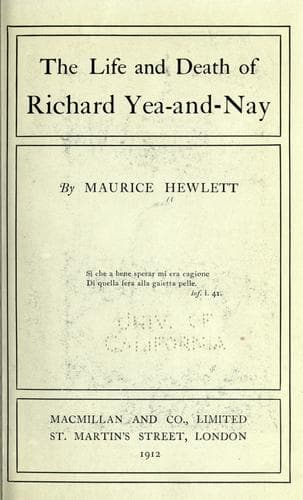
The Life and Death of Richard Yea-and-NayHewlett, Maurice
General
The Life and Death of Richard Yea-and-Nay
Hewlett, Maurice
Richard I, King of England, 1157-1199 -- Fiction
'That is the Marquess's way. But what matter? You want to see him down.
So do I, by heaven, but in hell, not on the earth. I will see him
tormented. I will see him ashamed. I will wreck his hopes. I will make
him a mockery of all kings, drag his high spirit through the mud of
disastrousness. Pouf! Do you think him all flesh? He is finer stuff than
that. What he makes others I seek to make him-soiled, defiled, a blown
rag. There is work to be done in that kind here and at home. King Philip
will see to one; I stay with the host.'
'It is a good plan,' said the Marquess; 'I admire it exceedingly. But
steel is safer for a common man. I go to Lebanon, for my part, to my
friends there. But I think we are in agreement.'
Before they went away, they cut their arms with a dagger, and mingled
their blood. The Marquess wrapped his wound deep in his cloak to keep
the flies from it. Across the silence of the night, as they made their
way into the city, came the cry of the watchman from a belfry: 'Save us,
Holy Sepulchre!' It floated from tower to tower, from land far out to
sea. Jehane, dry in her hot bed, heard it; Richard, on his knees in an
oratory, heard it, crossed himself, and repeated the words. Queen
Berengère moaned in her sleep; the Duke of Burgundy snored; and the
Arabian spat into the lagoon.
CHAPTER V
THE CHAPTER OF FORBIDDING: HOW DE GURDUN LOOKED, AND KING RICHARD HID
HIS FACE
Since the Soldan broke his pledges, King Richard swore that he would
keep his. So he had all the two thousand hostages killed, except the
Sheik Moffadin, whom the Marquess had enlarged. He has been blamed for
this, and I (if it were my business) should blame him too. He asked no
counsel, and allowed no comment: by this time he was absolute over the
armies in Acre. If I am to say anything upon the red business it shall
be this, that he knew very well where his danger lay. It was his
friends, not his enemies, he had reason to fear; and upon these the
effect of what he did was instantaneous, and perhaps well-timed. The
Count of Flanders had died of the camp-sickness; King Philip was
stricken to the bones with the same crawling disease. Nothing now could
keep Philip away from France. Acre was full of rumours, meetings of
kings and princes, spies, racing messengers. Who should stay and who go
was the matter of debate. Philip meant to go: his friend, Prince John of
England, had been writing to him. Flanders must be occupied, and
Flanders, near England, was nearer yet to Normandy. The Marquess also
meant to go--to Sidon for Lebanon. He had things to do up there on
Richard's and his own account, as you shall hear. But the Archduke chose
to stay in Acre--and so on.
King Richard heard of each of these hasty discussions with a shrug, and
only put his hand down when they were all concluded. He said that unless
French hostages were left in his keeping for the fulfilment of
covenants, he should know what to do.
'And what is that, King of England?' asked Philip.
Public-domain text, read in full here on John Shaqi.
Reviews
Reviews
No reviews yet
Be the first to share your thoughts on this work.
Elsewhere in the archive
Join the Discussion
Join the discussion
Sign in to leave a comment or review.
Sign InorCreate an account