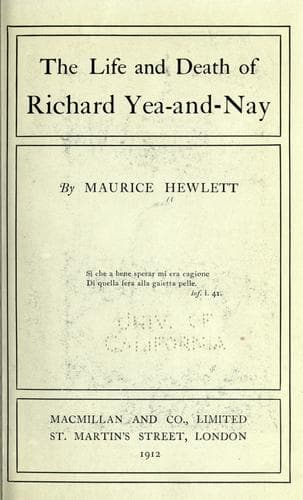
The Life and Death of Richard Yea-and-NayHewlett, Maurice
General
The Life and Death of Richard Yea-and-Nay
Hewlett, Maurice
Richard I, King of England, 1157-1199 -- Fiction
'What becomes me,' was the short answer, given in full hail before the
magnates. They looked at each other and askance at the sanguine-hued
King, who drove them all huddling before him by mere magnanimity. What
could they do but leave hostages? They left Burgundy, Beauvais, and
Henry of Champagne--one friend, one enemy, and one blockhead. Now you
see a reason for drawing the sword upon the wretched Turks. If Richard
had planted, they, poor devils, had to water.
So King Philip went home, and the Marquess to Sidon for Lebanon; and
Richard, knowing full well that they meant him ill here and at home,
turned his face towards Jerusalem.
* * * * *
When the time came for ordering the goings of his host, he grew very
nervous about what he must leave behind him in Acre. Whether he was a
good man or not, a good husband, a good lover or not, he was
passionately a father. In every surge and cry of his wild heart he
showed this. The heart is a generous inn, keeps open house, grows wide
to meet all corners. The company is divers. In King Richard's heart sat
three guests: Christ and His lost Cross, Jehane and her lost honour, and
little Fulke upon her breast. Christ was a dumb guest, but the most
eloquent still. There had been no nods from Him since the great day of
Fontevrault; but Richard watched Him daily and held himself bound to be
His footboy. See these desperate shifts of the great-hearted man! Here
were his two other guests: little Fulke, who claimed everything, and
still Jehane, who claimed nothing; and outside the door stood Berengère,
crisping and uncrisping her small hands. To serve Christ he had married
the Queen; to serve the Queen he had put away Jehane; to honour Jehane
(who had given him her honour) he had abjured the Queen. Now lastly, he
prayed Christ to save him Fulke, his first and only son. 'My Saviour
Christ,' he prayed on his last night at Acre, 'let Thine honour be the
first end of this adventure. But if honour come to Thee, my Lord,
through me, let honour stay with me and my son through Thee. I cannot
think I do amiss to ask so much. One other thing I ask before I go out.
Watch over these treasures of mine that I leave in pawn, for I know very
well that I shall get no more of them.' Then he kissed the mother and
the child, comforting them, and went out, not trusting himself to look
back at the house.
He had made the defences of Acre as good as he knew, which was very good
indeed. He had bettered the harbour; he left ships in it, established a
post between it and Beyrout, between Beyrout and Cyprus. He sent Guy of
Lusignan to be his regent in that island, Emperor if he chose. He left
Abbot Milo to comfort Jehane, the Viscount of Béziers to rule the town
and garrison. Shriven, fortified with the Sacrament, he spent his last
night in Acre on the 21st of August. Next morning, as soon as it was
day, he led his army out on its march to Jerusalem.
Public-domain text, read in full here on John Shaqi.
Reviews
Reviews
No reviews yet
Be the first to share your thoughts on this work.
Elsewhere in the archive
Join the Discussion
Join the discussion
Sign in to leave a comment or review.
Sign InorCreate an account