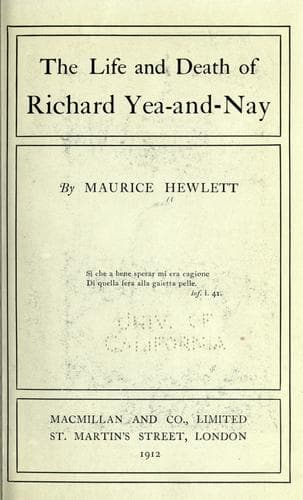
The Life and Death of Richard Yea-and-NayHewlett, Maurice
General
The Life and Death of Richard Yea-and-Nay
Hewlett, Maurice
Richard I, King of England, 1157-1199 -- Fiction
'I knew the man, my dear master and a great king, who brought the
leopards into the shield of England, more proper to do it than his
father, being more the thing he signified. Of him, therefore, torn by
two natures, cast in two moulds, sport of two fates; the hymned and
reviled, the loved and loathed, spendthrift and a miser, king and a
beggar, the bond and the free, god and man; of King Richard Yea-and-Nay,
so made, so called, and by that unmade, I thus prepare my account.'
So far the abbot with much learning and no little verbosity casts his
net. He has the weakness of his age, you observe, and must begin at the
beginning; but this is not our custom. Something of Time is behind us;
we are conscious of a world replete, and may assume that we have
digested part of it. Milo, indeed, like all candid chroniclers, has his
value. He is excellent upon himself, a good relish with your meal.
However, as we are concerned with King Richard, you shall dip into his
bag for refreshment, but must leave the victualling to me.
CHAPTER I
OF COUNT RICHARD, AND THE FIRES BY NIGHT
I choose to record how Richard Count of Poictou rode all through one
smouldering night to see Jehane Saint-Pol a last time. It had so been
named by the lady; but he rode in his hottest mood of Nay to that, yet
careless of first or last so he could see her again. Nominally to remit
his master's sins, though actually (as he thought) to pay for his own,
the Abbot Milo bore him company, if company you can call it which left
the good man, in pitchy dark, some hundred yards behind. The way, which
was long, led over Saint Andrew's Plain, the bleakest stretch of the
Norman march; the pace, being Richard's, was furious, a pounding gallop;
the prize, Richard's again, showed fitfully and afar, a twinkling point
of light. Count Richard knew it for Jehane's torch, and saw no other
spark; but Milo, faintly curious on the lady's account, was more
concerned with the throbbing glow which now and again shuddered in the
northern sky. Nature had no lamps that night, and made no sign by cry of
night-bird or rustle of scared beast: there was no wind, no rain, no
dew; she offered nothing but heat, dark, and dense oppression. Topping
the ridge of sand, where was the Fosse des Noyées, place of shameful
death, the solitary torch showed a steady beam; and there also, ahead,
could be seen on the northern horizon that rim of throbbing light.
'God pity the poor!' said Count Richard, and scourged forward.
Public-domain text, read in full here on John Shaqi.
Reviews
Reviews
No reviews yet
Be the first to share your thoughts on this work.
Join the Discussion
Join the discussion
Sign in to leave a comment or review.
Sign InorCreate an account