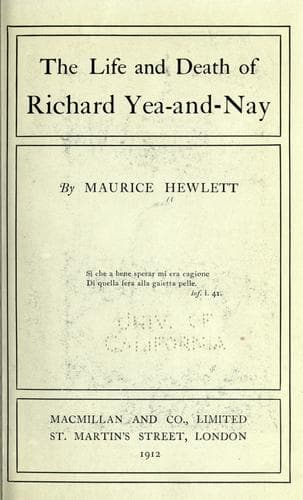
The Life and Death of Richard Yea-and-NayHewlett, Maurice
General
The Life and Death of Richard Yea-and-Nay
Hewlett, Maurice
Richard I, King of England, 1157-1199 -- Fiction
During this speech, which had much to recommend it, Richard, as I have
told you, did his thinking by himself. He always cooled as suddenly as
he boiled over; and now, warily regarding the right hand and the left of
this monstrous fable, he saw that, though Saint-Pol might have played
fox in it, another must have played goat. He could not fail to remember
Louviers, and certain horrid mysteries which had offended him then with
only vague disgust, as for matters which were outside his own care. Now
they all took shape satyric, like hideous heads thrust out of the dark
to loll their tongues at him. To the shock of his first dismay succeeded
the onset of rage, white and cold and deadly as a night frost. Eh, but
he would meet his teeth in some throat! But he would go slowly to work,
clear the ground and stalk his prey. The leopard devises creeping death.
He made up his mind. Gaston he sent to the South, to Angoulesme, to
Périgord, to Auvergne, to Cahors. The horn must be heard at the head of
every brown valley, the armed men shadow every white road. He himself
went to his city of Poietiers.
Bertran de Born saw him go, and rubbed his hair till it stood like reeds
shaken by the wind. Whether he loved mischief or not (and some say he
breathed it); whether he had a grudge against Anjou not yet assuaged;
whether he was in league with Prince John, or had indeed thought to do
Prince Richard a service, let philosophers, experts of mankind,
determine. If he had a turn for dramatics he had certainly indulged it
now, and given himself strong meat for a new Sirvente of Kings. At least
he was very busy after Richard's departure, himself preparing for a long
journey to the South.
CHAPTER VI
FRUITS OF _THE TENZON_: THE BACK OF SAINT-POL, AND THE FRONT OF
MONTFERRAT
Count Richard found time, while he was at Poietiers awaiting the
Aquitanian levies, to write six letters to Jehane Saint-Pol. Of these
some, with their bearers, fell by the wayside. As luck would have it,
Jehane received but two, the first and the last. The first said: 'I am
in the way of liberty, but by a red road. Have hopes of me.' Jehane was
long in answering. One may picture the poor soul taking the dear and
wicked thing into the little chapel, laying it on the altar-stone warm
from her vest, restoring it after office done to that haven whence she
must banish its writer. Fortified, she replied with, 'Alas, my lord, the
way of liberty leads not to me; nor can I serve you otherwise than in
bonds. I pray you, make my yoke no heavier.--Your servant, in little
ease, Jehane.' This wistful unhappy letter gave him heartache; he could
scarcely keep himself at home. Yet he must, being as yet sure of
nothing. He replied in a second and third, a fourth and a fifth letter,
which never reached her. The last was sent when he had begun what he
thought fit to do at Tours, saying, 'I make war, but the cause is
righteous. Never misjudge me, Jehane.' There were many reasons why she
should not answer this.
Public-domain text, read in full here on John Shaqi.
Reviews
Reviews
No reviews yet
Be the first to share your thoughts on this work.
Join the Discussion
Join the discussion
Sign in to leave a comment or review.
Sign InorCreate an account