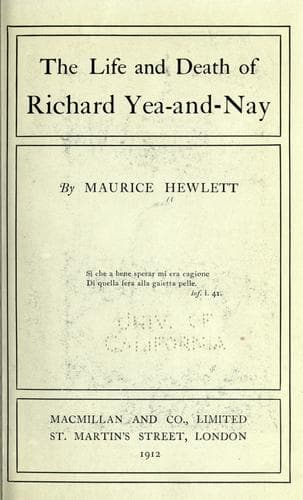
The Life and Death of Richard Yea-and-NayHewlett, Maurice
General
The Life and Death of Richard Yea-and-Nay
Hewlett, Maurice
Richard I, King of England, 1157-1199 -- Fiction
The brother, Count Eustace as they called him (to distinguish him from
an elder brother, Eudo Count of Saint-Pol), was a blunt copy of his
sister, redder than she was, lighter in the hair, much lighter in the
eyes. He seemed an affectionate youth, and clung to the great Count
Richard like ivy to a tree. Richard gave him the sort of scornful
affection one has for a little dog, between patting and slapping; but
clearly wanted to be rid of him. No reference was made to the journey,
much was taken for granted; Eustace talked of his hawks, Richard ate and
drank, Jehane sat up stiffly, looking into the fire; Milo watched her
between his mouthfuls. The moment supper was done, up jumps Richard and
claps hands on the two shoulders of young Eustace. 'To bed, to bed, my
falconer! It grows late,' cries he. Eustace pushed his chair back, rose,
kissed the Count's hand and his sister's forehead, saluted Milo, and
went out humming a tune. Milo withdrew, the servants bowed themselves
away. Richard stood up, a loose-limbed young giant, and narrowed his
eyes.
'Nest thee, nest thee, my bird,' he said low; and Jehane's lips parted.
Slowly she left her stool by the fire, but quickened as she went; and at
last ran tumbling into his arms.
His right hand embraced her, his left at her chin held her face at
discretion. Like a woman, she reproached him for what she dearly loved.
'Lord, lord, how shall I serve the cup and platter if you hold me so
fast?'
'Thou art my cup, thou art my supper.'
'Thin fare, poor soul,' she said; but was glad of his foolishness.
Later, they sat by the hearth, Jehane on Richard's knee, but doubtfully
his, being troubled by many things. He had no retrospects nor
afterthoughts; he tried to coax her into pliancy. It was the fires in
the north that distressed her. Richard made light of them.
'Dear,' he said, 'the King my father is come up with a host to drive the
Count his son to bed. Now the Count his son is master of a good bed, to
which he will presently go; but it is not the bed of the King his
father. That, as you know, is of French make, neither good Norman, nor
good Angevin, nor seethed in the English mists. By Saint Maclou and the
astonishing works he did, I should be bad Norman, and worse Angevin, and
less English than I am, if I loved the French.'
He tried to draw her in; but she, rather, strained away from him,
elbowed her knee, and rested her chin upon her hand. She looked gravely
down to the whitening logs, where the ashes were gaining on the red.
'My lord loves not the French,' she said, 'but he loves honour. He is
the King's son, loving his father.'
'By my soul, I do not,' he assured her, with perfect truth, then he
caught her round the waist and turned her bodily to face him. After he
had kissed her well he began to speak more seriously.
Public-domain text, read in full here on John Shaqi.
Reviews
Reviews
No reviews yet
Be the first to share your thoughts on this work.
Join the Discussion
Join the discussion
Sign in to leave a comment or review.
Sign InorCreate an account