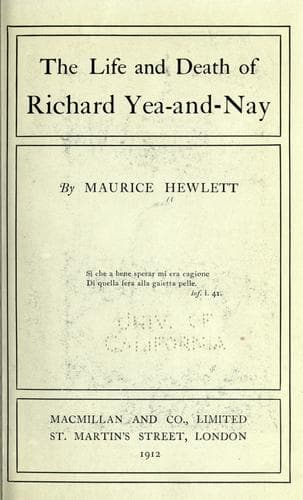
The Life and Death of Richard Yea-and-NayHewlett, Maurice
General
The Life and Death of Richard Yea-and-Nay
Hewlett, Maurice
Richard I, King of England, 1157-1199 -- Fiction
'For my part,' he concludes, 'when I consider the youth and fierce
untutored blood of this noblest of his race; or when I remember their
terrible names, Tortulf Forester, and Ingelger, Fulke the Black and
Fulke the Red, and Geoffrey Greygown and Geoffrey the Fair, and that old
Henry, the wickedest of all; their deeds also, how father warred upon
his sons, and sons conspired against their fathers; how they hated
righteousness and loved iniquity, and spurned monks and priests, and
revelled in the shambles they had made: then I say to myself, Good Milo,
how wouldst thou have received thy calling to be king and sovereign
count? Wouldst thou have said, as Count John said, "Lord Christ, Alain,
what shall we do?" Or rather, "God have mercy, I am very wicked." It is
true that Count John was not called to those estates, and that King
Richard was. But I choose sooner to think that each was confronted with
his dead father, and not the emptied throne. In which case Count John
thought of his safety and King Richard of his sin. Such musing is a
windy business, suitable to old men. But I suppose that you who read are
very young.'
CHAPTER XIII.
HOW THEY MET AT FONTEVRAULT
Communing with himself as he rode alone over the broomy downs, King
Richard reined up shortly and sent back a messenger for Milo the Abbot;
so Milo flogged his old mule. Directly he was level with his master,
that master spoke in a quiet voice, like one who is prepared for the
worst: 'Milo, what should a man do who has slain his own father? Is
repentance possible for such a one?'
Milo looked up first at the blue sky, then about at the earth, all green
and gold. He wrinkled close his eyes and let the sun play upon his face.
The air was soft, the turf springy underfoot. He found it good to be
there. 'Sire,' he said, 'it is a hard matter; yet there have been worse
griefs than that in the world.'
'Name one, my friend,' says the King, whose eyes were fixed on the edge
of the hill.
Milo said, 'There was a Father, my lord King Richard, who slew His own
Son that the world might be the better. That was a terrible grief, I
suppose.' The King was silent for a few paces; then he asked--
'And was the world much the better?'
'Beau sire,' replied Milo, 'not very much. But that was not God's fault;
for it had, and still has, the chance of being the better for it.'
'And do you dare, Milo,' said the King, turning him a stern face, 'set
my horrible offence beside the Divine Sacrifice?'
'Not so, my lord King,' said Milo at large; 'but I draw this
distinction. You are not so guilty as you suppose; for in this world the
father maketh the son, both in the way of nature and of precept. In
heaven it is otherwise. There the Son was from the beginning, co-eternal
with the Father, begotten but not made. In the divine case there was
pure sacrifice, and no guilt at all. In the earthly case there was much
guilt, but as yet no sacrifice.'
'That guilt was mine, Milo,' said Richard with a sob.
Public-domain text, read in full here on John Shaqi.
Reviews
Reviews
No reviews yet
Be the first to share your thoughts on this work.
Elsewhere in the archive
Join the Discussion
Join the discussion
Sign in to leave a comment or review.
Sign InorCreate an account