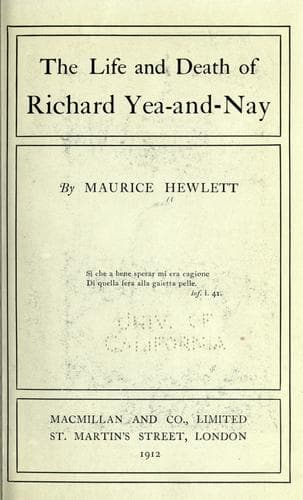
The Life and Death of Richard Yea-and-NayHewlett, Maurice
General
The Life and Death of Richard Yea-and-Nay
Hewlett, Maurice
Richard I, King of England, 1157-1199 -- Fiction
'Lord, I think not,' answered the old priest. 'You are what your fathers
have made you. But now mark me well: in doing sacrifice you can be very
greatly otherwise. Then if no more guilt be upon you than hangs by the
misfortunes of tainted man, you can please Almighty God by doing what
you only among men can do, wholesome sacrifice.'
'Why, what sacrifice shall I do?' says the King.
Milo stood up in his stirrups, greatly exalted in the spirit.
'My lord,' he said, 'behold, it is for two years that you have borne the
sign of that sacrifice upon you, but yet have done nothing of it. During
these years God's chosen seat hath lain dishonoured, become the wash-pot
of the heathen. The Holy Tree, stock beyond price, Rod of Grace, figure
of freedom, is in bonds. The Sepulchre is ensepulchred; Antichrist
reigns. Lord, Lord,'--here the Abbot shook his lifted finger,--'how long
shall this be? You ask me of sin and sacrifice. Behold the way.'
King Richard jerked his head, then his horse's. Get back, Milo, and
leave me,' he said curtly, struck in the spurs, and galloped away over
the grey down.
The cavalcade halted at Thouars, and lay the night in a convent of the
Order of Savigny. King Richard kept himself to himself, ate little,
spoke less. He prayed out the night, or most of it, kneeling in his
shirt in the sanctuary, with his bare sword held before him like a
cross. Next morning he called up his household by the first cock, had
them out on the road before the sun, and pushed forward with such haste
that it was one hour short of noon when they saw the great church of the
nuns of Fontevrault like a pile of dim rock in their way.
At a mile's distance from the walls the King got off his horse, and bid
his squires strip him. He ungirt his sword, took off helm and circlet,
cloak, blazoned surcoat, the girdle of his county. Beggared so of all
emblems of his grace, clad only in hauberk of steel, bareheaded, without
weapon, and on foot, he walked among his mounted men into the little
town of Fontevrault. That which he could not do off, his sovereign
inches, sovereign eye, gait of mastery, prevailed over all other robbery
of his estate. The people bent their knees as he passed; not a
few--women with babies in their shawls, lads and girls--caught at his
hand or hauberk's edge, to kiss it and get the virtue out of him that
is known to reside in a king. When he came within sight of the church he
knelt and let his head sink down to his breast. But his grief seemed to
strike inwards like a frost; he stiffened and got up, and went forward.
No one would have guessed him a penitent then, who saw him mount the
broad steps to meet his brother. Before the shut doors of the abbey was
Count John, very splendid in a purple cloak, his crown of a count upon
his yellow hair. He stood like a king among his peers, but flushed and
restless, twiddling his fingers as kings do not twiddle theirs.
Public-domain text, read in full here on John Shaqi.
Reviews
Reviews
No reviews yet
Be the first to share your thoughts on this work.
Elsewhere in the archive
Join the Discussion
Join the discussion
Sign in to leave a comment or review.
Sign InorCreate an account