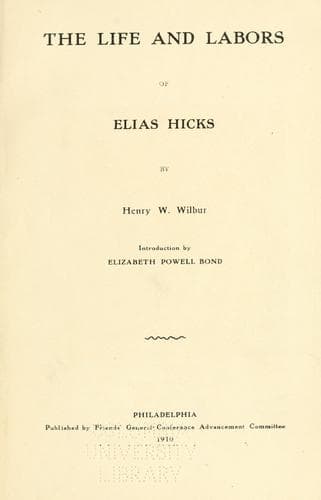
Elias Hicks was a much misunderstood man in his own time, and the
lapse of eighty years since his death has done but little to make him
known to the passing generations. His warm personal friends, and of
them there were many, considered him little less than a saint; his
enemies, some of whom were intensely bitter in their personal feeling,
whatever may have been the basis of their judgment, believed him to be
a man whose influence was malevolent and mischievous. It is no part
of the purpose of this book to attempt to reconcile the conflicting
estimates touching the life and character of this remarkable man.
On the contrary, our hope is to present him as he was, in his own
environment, and not at all as he might have been had he lived in our
time, or as his admirers would have him, to make him conform to their
own estimate. In this biographical task, Elias Hicks becomes largely
his own interpreter. As he measured himself in private correspondence
and in public utterance, so this book will endeavor to measure him.
We believe that it is not too much to say that he carried the
fundamental idea of the Society of Friends, as delivered by George Fox,
to its logical conclusion, as applied to thought and life, more clearly
and forcibly than any of his predecessors or contemporaries. Not a few
of those who violently opposed him, discounted the position of Fox
and Barclay touching the Inner Light, and gave exaggerated importance
to the claims of evangelical theology. Whatever others may have
thought, Elias Hicks believed that he preached Christianity of the pure
apostolic type, and Quakerism as it was delivered by the founders. It
should be remembered that the conformist and non-conformist disputants
of the seventeenth century talked as savagely about Fox as the early
nineteenth century critics did about Hicks. In fact, to accept the
theory of Fox about the nature and office of the indwelling spirit,
necessarily develops either indifference or opposition to the plans and
theories of what was in the time of Elias Hicks, if it is not now, the
popularly accepted theology.
No attempt has been made to write a comprehensive and detailed history
of the so-called "separation." So far, however, as the trouble related
to Elias Hicks, it has been considered, and as much light as possible
has been thrown on the case. Necessarily this does not admit of very
much reference to the setting up of separate meetings, which followed
the open rupture of 1827-28, or the contests over property which
occurred after the death of Elias Hicks. Even the causes of the trouble
in the Society only appear as they seem necessary to make plain the
feeling of Elias Hicks in the case, and the attitude of his opponents
toward him.
Public-domain text, read in full here on John Shaqi.
Reviews
Reviews
No reviews yet
Be the first to share your thoughts on this work.
Join the Discussion
Join the discussion
Sign in to leave a comment or review.
Sign InorCreate an account