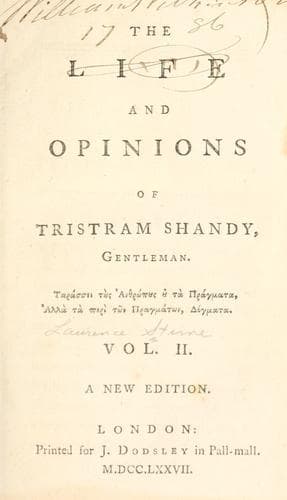
But there is perhaps little need to say more about a book which, though
some say that few read it through nowadays, is thoroughly well known in
outline and in its salient passages, and which will pretty certainly lay
hold of all fit readers as soon as they take to it. Of its writer a very
little more may perhaps be said, all the more so because those who, not
understanding critical admiration, think that biographers and editors
ought not only to be just and a little kind, but extravagantly partial
to their subjects, may conceive that I have been a little unjust, or, at
any rate, a little unkind to Sterne. If so, they have not read his own
extremely ingenious, and in general, if not in particular, very sound
attack on the adage _de mortuis_. But if not _nil nisi_, there is yet
very much _bonum_ to be said of Sterne. He was not merely endowed with a
singular and essential genius; he was not merely the representative and
mouthpiece, in a way hardly surpassed by any one, of a certain way of
thought and feeling more or less peculiar to his time. These were his
merits, his very great merits as a writer. But he had others, and great,
if not very great ones, as a man. Though never rich, he seems to have
been free from the fault of parsimony; and albeit he died in debt, not
deeply tainted with that of extravagance in money matters. For most of
his later expenditure was on others, and he might justly calculate on
his pen paying, and more than paying, his shot. Little love as there was
lost between him and his wife, he always took the greatest care to
provide for her wants in the rather costly severance of their
establishments, and never even in his most indiscreet moments hints a
grumble at her expenditure, a vice of which some people of much higher
general reputation have been known to be guilty. Though he was certainly
pleased at the attentions of “the great,” I do not know that there is
any just cause for accusing him of truckling to, or fawning on them
beyond the custom and courtesy of the time. For all his reckless humour,
there was no ill-nature in him. His worst enemies have admitted that his
affection for his daughter was very pretty and quite unaffected; and his
letters to and of Mrs. James show that he could think of a woman nobly
and wholesomely as a friend, for all his ignoble and unwholesome ways of
thought in regard to the sex. If it had not been for the cruel
indiscretion of his Lydia (which, however, has something of the old
virtue of conveying the balm as well as the sting), he would probably
have been much better thought of than he is. And considering the
delightful books here once more presented, I think we may consent to
forgive the faults which, after all, were mainly his own business, for
the merits by which we so largely benefit and for which he reaped no
over-bounteous guerdon.
GEORGE SAINTSBURY.
Public-domain text, read in full here on John Shaqi.
Reviews
Reviews
No reviews yet
Be the first to share your thoughts on this work.
Join the Discussion
Join the discussion
Sign in to leave a comment or review.
Sign InorCreate an account