The foregoing remarks of Bullinger show with what caution our
forefathers were obliged to speak of Zwingli's political acts. Indeed,
after the battle of Cappel they were looked upon with little favor,
even in the Reformed portion of the Confederacy. Bullinger himself,
Zwingli's successor, was for the moment filled with despondency. He
wrote to his friend, Myconius: "We will never come together again. No
one trusts his neighbor any longer. Surely, surely, we live in the last
times. It is all over with the Confederacy." The passage above-cited
was written perhaps at this juncture. But he soon recovered his
courage. His confidence in God returned with renewed strength, and he
then began that career, which was so active, so noble and so full of
blessing. He continued the work of his illustrious predecessor, and
described it also with a powerful pen and a reverent heart, leaving
behind, for thoughtful readers at least, intimations of what he durst
not wholly reveal to his contemporaries. Three centuries have since
gone by, and unrestricted access to archives and multiplied
investigations have brought to light reports and documents hitherto
unknown. From these materials, the author endeavored, fifteen years
ago, to delineate the life and times of Zwingli. That volume was
designed for those, who study history as a science: the aim of this one
is to present the same results in a popular form. And as our people,
now a-days, pay so much attention to what is written and spoken, let
them hear once more the voice of one of the noblest statesmen of former
ages; let them consider his acts, and ponder over his sad fate. If we
regard him merely as a reformer of the Church, he may perhaps appear to
us surrounded by a brighter glory; but history demands a full
representation, and such a representation exhibits him as a man
"possessed of like passions with ourselves." Yet, just in the
acknowledgement of his own infirmities by Zwingli, and in his
submission with humble faith to a Higher Power, do the unmistakable
features of true religion shine victoriously above that worship of self
which springs only from vain conceit.--May the following work produce
the same conviction in the mind of the reader!
Preface.
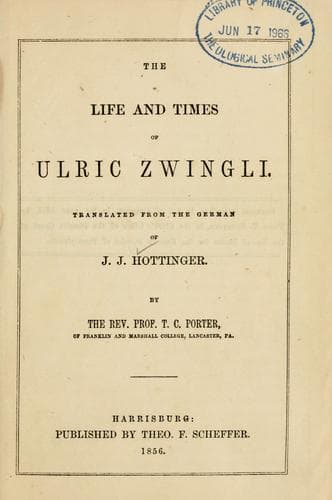
The volume, here translated, was published in Zurich in the year 1842,
and may be regarded as the fullest and most reliable history of Zwingli
and his times that has yet appeared; for, in addition to the numerous
works, in Latin and German, which relate to this particular period, the
author has had free access to an immense mass of important and
necessary state-papers, long buried in the archives of the Canton.
Contents.
CHAPTER FIRST. _Page._
Zwingli's youth. His labors in Glarus and Einsiedeln, 7
CHAPTER SECOND.
Public-domain text, read in full here on John Shaqi.
Reviews
Reviews
No reviews yet
Be the first to share your thoughts on this work.
Join the Discussion
Join the discussion
Sign in to leave a comment or review.
Sign InorCreate an account