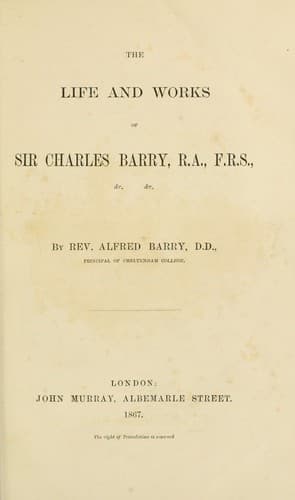
The life and works of Sir Charles BarryBarry, Alfred
General
The life and works of Sir Charles Barry
Barry, Alfred
Architects -- Great Britain -- Biography; Barry, Charles, 1795-1860
The petition however was prepared, and presented by Mr. Hume, on June
22nd, 1836; it was grounded mainly on the fact that four Commissioners
only signed the award, and the assertion that in that award
considerations of expense and the conditions of competition were
disregarded; its prayer was for a fresh investigation of the whole
matter. This was followed up in a formal attack by Mr. Hume, on July
22nd, based on the alleged ground of the alterations made in the plan,
but showing a characteristic alarm at the prospect of large expenditure.
The Commissioners’ award was ably defended by Mr. Tracy (afterwards Lord
Sudeley), one of their number. But the question was settled at once by a
speech of Sir R. Peel, in which he pointed out, with obvious truth, that
if Mr. Hume’s suggestions were adopted the “whole principle of
competition would be destroyed,” and the public faith endangered; and
expressed a pity (somewhat prophetic) for the successful competitor as a
man already “hunted and pursued,” “_cui sua mortifera est victoria_.” It
was impossible to resist such an argument, even had the criticisms on
the successful design been impartial, and the unpopularity of it real.
But, in fact, the opposition was almost entirely professional, and in
the profession itself it did not pass unquestioned. For the debate was
followed by the publication of a protest of twelve competitors, against
the proceedings of the original meeting of dissentients and the
presentation of the petition, on the ground that the steps taken to
overturn the petition were “indecorous and unprofessional,” and that the
whole proceedings tended to disunion in the architectural profession.
This protest was signed by Messrs. Donaldson, Angell, Kendall, Mocatta,
Davies, Morgan, Wallace, Hakewill, Robinson, Blore, Lamb, and Bardwell.
After this the opposition gradually died away, except in anonymous
attacks.
During the whole of this time Mr. Barry, by the advice of his friends,
had remained silent. He felt deeply the painful position in which he was
placed, and, most of all, certain insinuations, touching not only his
own character, but that of Sir E. Cust. It was asserted that he was “Sir
E. Cust’s tool,” that the design in fact was that gentleman’s, and he
only his draughtsman.[66] It was a relief to know that the Select
Committee of the House of Commons, appointed to consider the question in
March, 1836, gave opportunity for the following evidence from Sir E.
Cust[67]--
_Lord Francis Egerton._ You make mention of Mr. Barry’s plan; do
you mean to imply you knew it to be Mr. Barry’s plan at the time
you considered it?
Public-domain text, read in full here on John Shaqi.
Reviews
Reviews
No reviews yet
Be the first to share your thoughts on this work.
Elsewhere in the archive
Join the Discussion
Join the discussion
Sign in to leave a comment or review.
Sign InorCreate an account