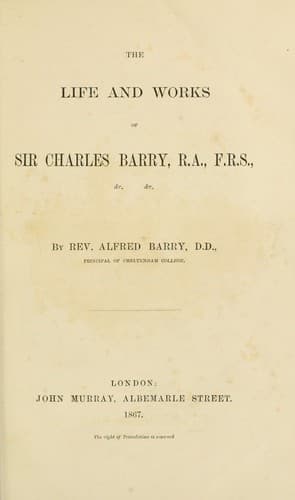
The life and works of Sir Charles BarryBarry, Alfred
General
The life and works of Sir Charles Barry
Barry, Alfred
Architects -- Great Britain -- Biography; Barry, Charles, 1795-1860
But the storm of personal opposition and abuse which followed cannot be
so easily excused. At first anonymous attacks appeared in newspapers on
the “highly ornamented and meretricious” character of the design, on the
dangerously artistic beauty of the drawings, as tending to mislead the
judges, and on the incompetency of the judges themselves, who were
designated as mere amateurs. Hints were even ventured upon as to the
favourable disposition of the chief commissioner towards Mr. Barry. It
was pronounced that the competition was a “complete failure,” and that
it ought to be renewed on a different basis, and with a greater freedom
of choice as to style. When the design was altered and enlarged, to suit
an extension of the site, the alteration was called a plagiarism, and
alleged to vitiate the selection of the judges. All this was bad enough,
but it is only that to which all public men are exposed, an acknowledged
drawback to the great benefit of a free press, which will exist as long
as anonymous writing is recognised. If this had been all, it might have
been patiently borne.
But it was not all. Far more decided and unusual measures followed. An
exhibition of the unsuccessful designs was opened on March 21st, 1836,
with a view to invite comparisons. Finally a meeting of the unsuccessful
competitors was held, to take steps to set the award aside. The chairman
(one of the most distinguished of the unsuccessful competitors) stated
the case, as one in which public duty must conquer private friendship,
and defy the danger of misconstruction as to the motives of action; and
after some discussion it was resolved, that the award of the judges was
not confirmed by the public, that the prizemen did not merit the
preference which that award gave them, that, in fact, a board of amateur
judges was necessarily incompetent, and that a petition should be made
to be heard at the bar of the House of Commons, to show cause for a
competent commission to revise the whole proceedings.
The resolutions did not pass without energetic protest, especially from
Mr. (now Prof.) Donaldson. It was urged by him (as by Sir E. Cust, in a
pamphlet subsequently published) with a force and truth fatal to the
objectors, that all these proceedings came too late, and that those, who
by competing had acknowledged the judges, could not now with any
propriety vilify them, and set their decision aside.
Public-domain text, read in full here on John Shaqi.
Reviews
Reviews
No reviews yet
Be the first to share your thoughts on this work.
Elsewhere in the archive
Join the Discussion
Join the discussion
Sign in to leave a comment or review.
Sign InorCreate an account