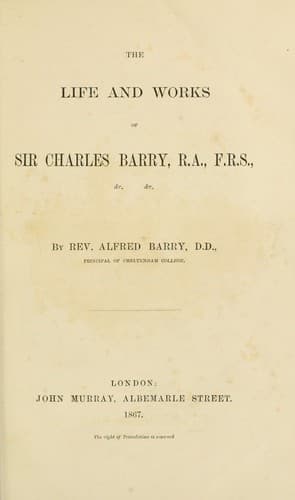
The life and works of Sir Charles BarryBarry, Alfred
General
The life and works of Sir Charles Barry
Barry, Alfred
Architects -- Great Britain -- Biography; Barry, Charles, 1795-1860
The temporary accommodation provided for the House of Lords was both
insufficient and inconvenient, while their old house, which had been
surrendered for the use of the House of Commons, afforded every
convenience and comfort. It was natural, perhaps inevitable, that the
delay in the completion of the new House of Peers should create
dissatisfaction. This feeling found its vent in the appointment of a
Committee of Enquiry, which began its sittings in 1844, and reported
from time to time to the House. In the course of its investigations it
was found that several departures from the original design (which are
noticed in the next chapter) had taken place, especially in respect of
the royal approach and staircase. It was allowed in evidence by Lord
Sudeley (Mr. Hanbury Tracy) one of the original Commissioners of
Selection, that it “never was the idea, expectation, or wish of the
Commissioners, that Mr. Barry should be confined to the plan approved
of.” It was contended by the architect, that the alterations were either
alterations of detail, not affecting the main features of the building
and not increasing the expense, or else such as were necessitated by the
requirements of further accommodation by the Board of Works, and
therefore having “direct or implied authority.” But the Committee judged
otherwise, and called the “special attention of the House” to the fact,
that “alterations had been made by the architect without due authority.”
This Report was equivalent to a public censure. Not only the decision of
the Committee itself, but also the tone of much of the examination,
naturally caused Mr. Barry the greatest possible mortification. Had the
Government assumed the same tone in its dealings with him, it is very
doubtful whether he would have been able to continue the work. But the
cordial and generous support of the late Duke of Newcastle (then Earl of
Lincoln and First Commissioner of the Board of Works), both set him
right in public estimation, and gave him personally the greatest
encouragement and comfort. His Lordship, in his evidence before the
Committee, while assuming for his office the power and responsibility of
a rigid control of expenditure, yet urged forcibly the necessity of
allowing much scope to the architect of a great public work, and of
giving him a free and liberal support. He declared his perfect
accordance with Mr. Barry in all the steps hitherto taken, while (in
order to meet the views of the Committee) he arranged that for all
subsequent alterations the previous sanction of the Board of Works
should be formally asked and obtained. The effect of this firm and
generous support was at once visible in the milder tone of the second
Report of the Lords Committee.
Public-domain text, read in full here on John Shaqi.
Reviews
Reviews
No reviews yet
Be the first to share your thoughts on this work.
Elsewhere in the archive
Join the Discussion
Join the discussion
Sign in to leave a comment or review.
Sign InorCreate an account