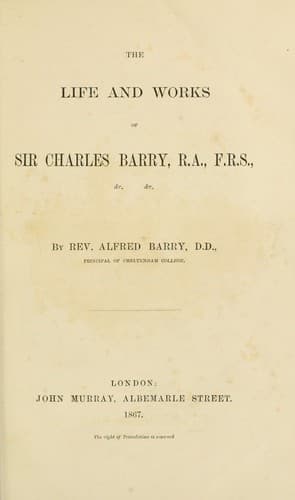
The life and works of Sir Charles BarryBarry, Alfred
General
The life and works of Sir Charles Barry
Barry, Alfred
Architects -- Great Britain -- Biography; Barry, Charles, 1795-1860
But the matter was not allowed to rest here. The question of the
alterations made attracted attention in the House of Commons, and a
Committee was appointed to investigate the matter still more closely.
The result was a Report declaring that “the Committee impute no blame to
Mr. Barry for the course he had taken, and have every reason to believe,
that all the alterations hitherto made have conduced to the convenience
and general effect of the building.” They approved (as the Lords’
Committee had done) of the new arrangement made by the Board of Works;
but they did so expressly on the ground of the “misapprehension”
existing as to the course hitherto pursued.
Thus the difficulty, which had seemed most formidable, passed away. It
was allowed by the architect that alterations, _not involving additional
expense_, had been made by his own authority. It is clear that, even if
the requirements of the public service had not varied, many alterations
must have suggested themselves in the carrying out of so great a work.
It was allowed on the other side, that some measure of freedom must be
granted to an architect, whose professional character and hope of future
reputation were at stake, in the endeavour to make his building as
perfect as possible. The only question was, whether the design, in its
main features, was still a fair development of that originally selected.
This being decided in Mr. Barry’s favour, all serious opposition was at
an end, while the opposition already experienced acted perhaps as an
useful corrective to his natural tendency to alteration and development
of plan.
It was, no doubt, in consequence of the difficulties above noticed, that
a Commission was appointed on March 17th, 1848, to “superintend the
completion of the New Palace.” The Commissioners were Earl de Grey, Sir
John F. Burgoyne, and T. Greene, Esq., M.P. They were to “determine upon
all designs for fittings, decorations,” &c., “all modifications of
plan,” “all arrangements for warming, ventilating, and lighting the
building,” subject to the approval of the Treasury, whenever additional
cost should be proposed. The office must have been a difficult one,
between the Treasury on the one hand and the Board of Works on the
other, and although their relations with the architect were of the most
friendly character, I cannot find that their appointment greatly
facilitated the progress of the work.
Such difficulties must be expected by all who work for the public. No
one can question the right of the Houses of Lords and Commons to
examine, censure, and indirectly control, those who are working for
their service. But then these public servants should be left free from
other interference, with undivided power and undivided responsibility.
Public-domain text, read in full here on John Shaqi.
Reviews
Reviews
No reviews yet
Be the first to share your thoughts on this work.
Elsewhere in the archive
Join the Discussion
Join the discussion
Sign in to leave a comment or review.
Sign InorCreate an account