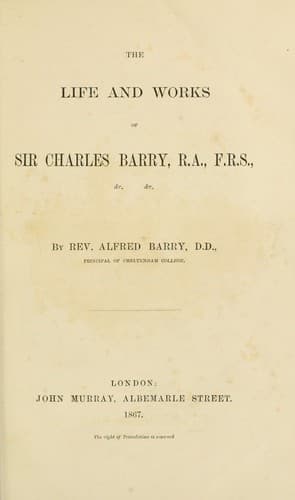
The life and works of Sir Charles BarryBarry, Alfred
General
The life and works of Sir Charles Barry
Barry, Alfred
Architects -- Great Britain -- Biography; Barry, Charles, 1795-1860
In May 31st, 1848, Mr. E. B. Denison first appears on the scene, in an
eminently characteristic letter to Lord Morpeth, accusing Mr. Barry of
“acting in concert with Mr. Vulliamy” to set aside the decision of the
Astronomer Royal, endeavouring to persuade Lord Morpeth that “he is
familiar with the art of clockmaking, contriving to prevent the clock
being ordered,” and the like. No proofs are given of these statements,
made as they are in a letter to Lord Morpeth, to be submitted to the
Commissioners for the New Palace. At the same time, August, 1848, Mr.
Vulliamy applied for the two hundred guineas, which was to be his full
payment, offering to return one hundred guineas in case of his being
employed; but the Commissioners declined to recommend a payment of more
than one hundred guineas, on the ground, that there was “no probability
of any decision being required at present relative to the person to be
employed to make the clock,” (June, 1849).
The matter still lingered, till towards the end of 1851 Mr. Denison was
requested by Lord Seymour, the Chief Commissioner of Works, apparently
at the suggestion of the Astronomer Royal, to act with that gentleman in
the matter of the clock. He at once (to use his own words) examined, so
far as was possible, the various plans, and “was soon convinced that
none of them would do.” He therefore drew up a general specification,
accepted by Mr. Dent, in accordance with which the clock was to be made
under the direction of Professor Airy and Mr. Denison, for 1800_l._, and
within the space of two years. This arrangement was formally sanctioned
by the Board of Works, and thus for the first time the matter was put
fairly in train.
The clock-tower had been in progress since 1843, and was now about 150
feet from the ground. The internal shaft (11 feet by 8 feet 6 in.) was
of the same area on plan all the way up, and no hint had been given,
that it was not amply sufficient for any clock which was likely to be
required. But it now appeared, that the plan of the internal shaft was
in some points inconsistent with Mr. Dent’s plan of the clock, and some
modifications which appear to have been inconsiderable,[75] were made by
Mr. Dent, in order to remove that difficulty. It is to be observed, that
the architectural arrangements were all made before the clock was
ordered at all.
Public-domain text, read in full here on John Shaqi.
Reviews
Reviews
No reviews yet
Be the first to share your thoughts on this work.
Elsewhere in the archive
Join the Discussion
Join the discussion
Sign in to leave a comment or review.
Sign InorCreate an account