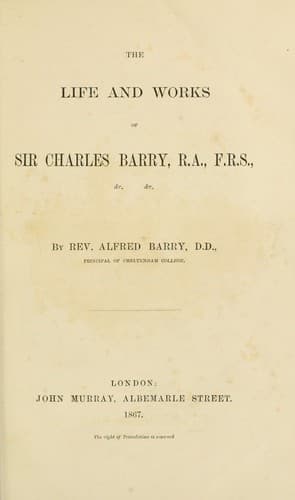
The life and works of Sir Charles BarryBarry, Alfred
General
The life and works of Sir Charles Barry
Barry, Alfred
Architects -- Great Britain -- Biography; Barry, Charles, 1795-1860
After this the work proceeded steadily, and (as Professor Airy was
abroad for some time) it proceeded under Mr. Denison’s sole direction.
So long as Professor Airy was able to take an active part in the work,
no difficulty seems to have occurred. But now a proposal was made by
Lord John Manners (who had succeeded Lord Seymour) that some other
referees should be appointed, and that the architect should be one of
them. This proposal seems to have greatly excited Mr. Denison’s wrath;
but, considering the trouble which Mr. Barry had already had from the
appointment of persons to carry out works on the building, independent
of himself and uncontrolled by any superior power, considering also the
temper which Mr. Denison’s letters had shown, and the unreserved way in
which he had identified his interests with those of Mr. Dent, it will
probably not appear so entirely ridiculous or unreasonable to others.
As soon as the arrangements were made public, a memorial of the
“masters, wardens, and court of assistants of the Clockmakers’ Company
of the City of London” was presented to Lord John Manners, to the
following effect, that, the original design and plan of the clock being
altered, a fresh competition ought to take place, but that, if this was
impossible, some committee of referees should be appointed in
conjunction with the Astronomer Royal and Mr. Denison, including the
architect and Sir J. (or Mr. George) Rennie, _as originally proposed by
Mr. Dent_. To this memorial the natural answer was given, viz., that the
arrangements were already definitely made with Mr. Dent for the
construction of the clock, but that the question of additional referees
was under the consideration of the Chief Commissioner. A rejoinder was,
however, written by Mr. Denison, referring the memorial to Mr. Vulliamy
and “a certain set of clockmakers,” instead of treating it as, what it
certainly was, an official document of the Company, and containing
imputations of motives of underhand conduct against Lord J. Manners, Sir
C. Barry, &c., which, as being incapable of formal proof or formal
refutation, it is not usual to admit into official documents. Lord John
Manners naturally declined to enter into controversy, and proposed Mr.
Robert Stephenson as additional referee; but he did not think fit to
press the proposal, when it was met by Mr. Denison with a declaration,
that the Astronomer Royal and himself would resign, rather than admit of
any change in the footing on which they had consented to act.
Public-domain text, read in full here on John Shaqi.
Reviews
Reviews
No reviews yet
Be the first to share your thoughts on this work.
Elsewhere in the archive
Join the Discussion
Join the discussion
Sign in to leave a comment or review.
Sign InorCreate an account