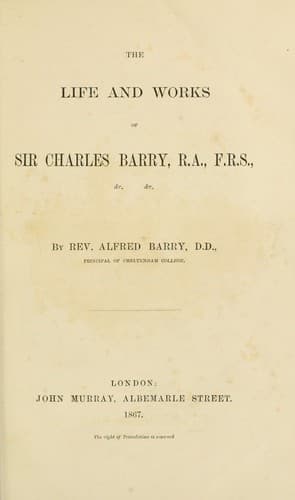
The life and works of Sir Charles BarryBarry, Alfred
General
The life and works of Sir Charles Barry
Barry, Alfred
Architects -- Great Britain -- Biography; Barry, Charles, 1795-1860
At this time Mr. Dent died, and his successor, Mr. F. Dent, claimed to
succeed to the contract. Some doubt was entertained by the Government,
based on legal opinions, whether they were bound to accept this
succession. They did not, however, desire to injure Mr. Dent; they were
prepared at once to make a new contract, based on the terms of the
existing specification, with this single additional provision, that the
approval of the clock should “be vested in the Chief Commissioner (then
Sir W. Molesworth) acting under the advice and with the assistance of
the Astronomer Royal and Mr. Denison, or either of them, should any
difference of opinion arise between the two.” This reason of this
provision will be obvious from a letter of the Astronomer Royal dated a
few days before (November 7th, 1853), in which he stated, that, since
Mr. Denison’s appointment at his suggestion, subsequent intercourse,
while it had “confirmed his high opinion of that gentleman’s mechanical
ingenuity and horological knowledge, had shown that their ideas of the
mode of conducting public business were very different, and had at last
forced on him the conviction that they could not with advantage profess
to act in concert.” Professor Airy had therefore tendered his
resignation. After an interview, the Chief Commissioner induced him to
withdraw the tender; but it would not appear that he took any active
part in the subsequent proceedings.
It however proved that the Board had indirectly recognised Mr. F. Dent
as succeeding to the contract. The law officers of the Crown, though
declaring that this “did not alter the legal bearings of the case,”
advised that the contract should be allowed to go on as before, but that
the Board should insist on “the substitution of some other referee or
referees.” This last recommendation was not insisted upon, and all
accordingly proceeded on the old footing.
The clock was completed by Mr. Dent in 1855, and 1600_l._ was paid him
on account. It however could not be hoisted to its place, and much
discussion took place on the question, whether the tower was waiting for
the clock, or the clock waiting for the tower. In fact, neither of these
things was true. Both were waiting for the bells. As will be seen below,
the tower was roofed in by Sir Charles in 1856, after he had waited in
vain for some information about the bells, the tenders for which were
accepted in 1855, but which were not finally ready till 1859. This
necessitated the taking up the bells by the clock shaft, and so the
clock could not be fixed till 1859.
Its troubles were not yet over. The weight of the hands was too great,
and a vehement controversy, carried on in the usual spirit, took place
in the ‘Times’ as to whether the blame of this did or did not rest upon
Sir C. Barry.[76] Finally the difficulty was remedied, and the clock has
been going on well up to the present time. As a piece of workmanship, it
appears to do great credit both to Mr. Denison and to Mr. Dent.
Public-domain text, read in full here on John Shaqi.
Reviews
Reviews
No reviews yet
Be the first to share your thoughts on this work.
Elsewhere in the archive
Join the Discussion
Join the discussion
Sign in to leave a comment or review.
Sign InorCreate an account