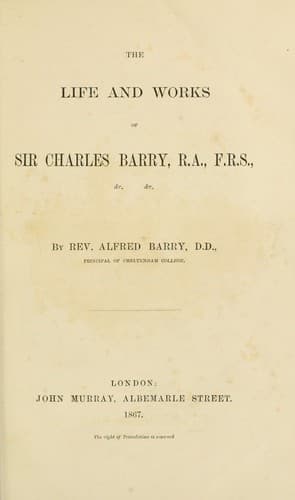
The life and works of Sir Charles BarryBarry, Alfred
General
The life and works of Sir Charles Barry
Barry, Alfred
Architects -- Great Britain -- Biography; Barry, Charles, 1795-1860
In order to carry out the ideas embodied in the scheme of the
Commissioners, great exhibitions of cartoons and sculpture took place in
Westminster Hall. Premiums were offered, and commissions were given to
those who gained the highest places in this grand competition. The work
is still going on, and (it is to be hoped) will be continued, till
something like the ideal proposed in the reports shall be realized. Few
buildings could be better adapted to serve as a British “Walhalla.” The
natural wish for the perpetuation of memorials of great men and great
events has filled St. Paul’s and Westminster Abbey with monuments,
seldom fitted for places of Christian worship and Christian sepulture.
Such monuments might well find a place in future in a building, which is
at once a palace of the Sovereign and the home of the legislature,--a
building moreover, which by its extent and by its publicity gives the
greatest possible scope for such commemoration of the past. When we look
at what has been already done by the hands of our most celebrated
artists, it is impossible not to feel that already the object of the
Commission has been, to a great extent, attained, and a great
opportunity nobly used. It is to be hoped, that even now such
modifications may be made, during the continuance of the work, as may do
away with all such drawbacks as those noticed above, and secure the
harmony needed for grandeur of effect.
But, if it was Mr. Barry’s fate thus to encounter opposition and
difficulty, it was his good fortune in the execution of his great work
to draw round him men, who would work heartily under his direction, and
yet would bring to their work all the enthusiasm and the high artistic
spirit, which are usually supposed to belong only to independent
workers. The opportunity was a great one; the scale of the building, the
supplies given from the public purse, and (for a considerable time) the
large discretion left to the architect in the employment of those
resources, were at that time unprecedented. Mr. Barry felt the greatness
of the opportunity. Not only did he desire to make his building a
treasure-house of art and a sculptured memorial of our national history,
but he also hoped to raise up in the course of its execution a school of
decorative art, guided, but not servilely confined, by the examples of
Gothic antiquity, and bringing to the evolution of Gothic principles all
the resources of modern thought and science.
His ideas on the former point are embodied in the communication to the
Fine Arts Commission, which is quoted above. The appointment of the
Commission, of which (as has been remarked) he was not made a member, to
a great extent took the highest artistic decoration out of his hands;
and, but for his strenuous resistance, would have interfered even with
purely architectural details. Still, however, much remained in his
power; and his hopes in this direction did not fail of considerable
accomplishment.
Public-domain text, read in full here on John Shaqi.
Reviews
Reviews
No reviews yet
Be the first to share your thoughts on this work.
Elsewhere in the archive
Join the Discussion
Join the discussion
Sign in to leave a comment or review.
Sign InorCreate an account