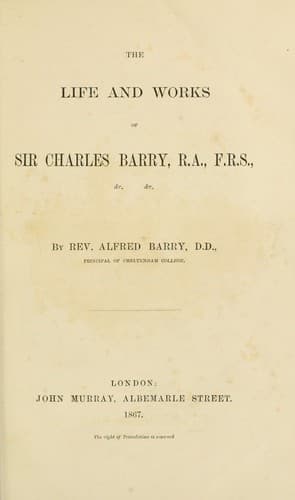
The life and works of Sir Charles BarryBarry, Alfred
General
The life and works of Sir Charles Barry
Barry, Alfred
Architects -- Great Britain -- Biography; Barry, Charles, 1795-1860
Nor was he disappointed in his other expectation. In the extraordinary
progress of decorative art during the last twenty years the work in the
New Palace of Westminster may justly claim a large share of influence.
Infinite pains were bestowed on every detail; in some cases it seemed,
that the dignity of the building as a whole, rather than the absolute
need or object of the particular part under consideration, was allowed
to determine the care and elaboration to be bestowed upon it. In the
whole of the enormous mass there is hardly a square yard, which was not
the subject of careful study. It was rather an understatement than an
exaggeration of the truth, when the architect was forced to state to the
Government that “no less than between 8000 or 9000 original drawings and
models have been prepared for it, a large portion of which have emanated
from my own hand, while the whole of the remainder have been made under
my own immediate direction and supervision.” It was impossible that this
extraordinary labour should be wholly thrown away. It could not fail to
advance that cause of decorative art, to which it was so unsparingly
devoted. But Mr. Barry was well aware that such a work could not be
carried out by the unaided exertions of a single man. It was his good
fortune to give direction and stimulus to a crowd of artistic
coadjutors; it is the duty and privilege of those, who cherish his
memory, to record with the most unreserved acknowledgment the valuable
aid which he received from them.
Foremost among all stands the name of the late Mr. Pugin. It was (as has
been said) during the erection of the Birmingham Grammar School in 1835
that he first became known to Mr. Barry, and at that time his help was
first received in designing certain details of the interior. From the
first moment of their acquaintance the connection between them became
warm and friendly. Agreeing in their entire devotion to art, and
differing widely in character and in artistic principles, they had
perhaps just that amount of sympathy and diversity, which leads to
mutual appreciation, co-operation, and friendship. Unrestrained as
their intercourse and mutual criticisms were--impossible, in fact, as it
would have been to restrain either in the assertion of what he conceived
to be orthodoxy in architectural faith--that intercourse was untroubled
by the slightest misunderstanding or estrangement of feeling, from the
time that they first saw each other in Birmingham, till the day when Sir
C. Barry was one of the few mourners who followed his friend to the
grave.
Public-domain text, read in full here on John Shaqi.
Reviews
Reviews
No reviews yet
Be the first to share your thoughts on this work.
Elsewhere in the archive
Join the Discussion
Join the discussion
Sign in to leave a comment or review.
Sign InorCreate an account