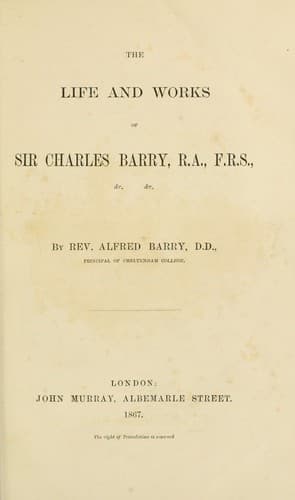
The life and works of Sir Charles BarryBarry, Alfred
General
The life and works of Sir Charles Barry
Barry, Alfred
Architects -- Great Britain -- Biography; Barry, Charles, 1795-1860
It would be an almost endless work to recount the names of those who
worked under his direction in the decoration of the New Palace. Messrs.
Hardman in respect of the stained glass, Mr. Crace in the ornamental
painting, Mr. Minton in the supply of the encaustic tiles, took far more
than a commercial interest in the work. It is said truly, that much of
the beauty and vigour of mediæval works arises from the fact, that the
actual decorators worked artistically, with a view to the excellence of
their work, and not merely to the wages to be received for it. If this
spirit is reviving, or has revived, in the present day, much is probably
due to the work on the New Palace at Westminster, where there certainly
was in a very high degree this feeling among those who took subordinate
parts in the work. It can be hardly wrong to attribute some measure at
least of this feeling to the enthusiasm for art which actuated the
leader. It is certainly a duty to record the deep sense which he
entertained of it, and the support and encouragement which it gave him.
With these difficulties and with these supports, the work proceeded
steadily and energetically. The time which elapsed from the actual
commencement of the work in 1840, to the opening of the main part of the
building in 1852, cannot be considered long, if the extent of the work
be calculated, and its various drawbacks allowed for.
In February, 1847, the House of Peers was for the first time occupied,
not with any ceremonial opening, but for ordinary public business. Some
difficulty was at first apprehended as to the acoustic properties of the
House; but as soon as the Peers became more used to their new House, the
difficulty was greatly diminished, if not entirely removed.
Meanwhile the rest of the building proceeded rapidly. The public
approaches were completed, the committee-rooms gradually prepared for
use, and at last the House of Commons was opened. The temporary house
having been very convenient, the members of the Lower House had not been
very anxious to enter their new quarters. When they did so, they were
somewhat dissatisfied with the change. In the construction of the House
the architect had acted upon the instructions and advice of the leading
officials; and the general effect of these instructions had been greatly
to diminish the dimensions originally proposed, for the accommodation
both of the House and the public.[85]
Public-domain text, read in full here on John Shaqi.
Reviews
Reviews
No reviews yet
Be the first to share your thoughts on this work.
Elsewhere in the archive
Join the Discussion
Join the discussion
Sign in to leave a comment or review.
Sign InorCreate an account