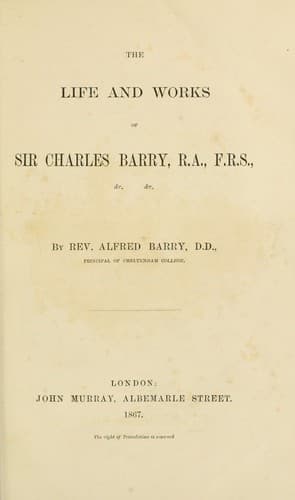
The life and works of Sir Charles BarryBarry, Alfred
General
The life and works of Sir Charles Barry
Barry, Alfred
Architects -- Great Britain -- Biography; Barry, Charles, 1795-1860
But an architect’s work is not purely artistic. The construction both of
the New Palace itself and of the scaffolding used in its erection, taxed
heavily scientific knowledge and ingenuity.[84] In fact, the whole
timber or framed scaffolding, with travellers, by which a stone, perhaps
elaborately carved, could be raised from the ground, and placed in its
proper position, had seldom, if ever, before been employed on so large a
scale. The constructional difficulties introduced by the need of
preservation of old buildings, and of piecemeal occupation of the new
ones, were great. But even greater were those caused by the frequent
change and increase of official requirements in the course of the work;
and most of all by the appointment of Dr. Reid, and his enormous claims
of space for warming and ventilation, never known till the whole
arrangement of plan and construction was settled.
Into all these difficulties Mr. Barry himself fully entered. He felt a
positive pleasure in the expedients by which they were to be met; and in
the invention of such expedients he was full of resources, and bold even
to the verge of rashness. But his knowledge was more practical than
theoretical, and in his work he received the most valuable assistance
from the scientific knowledge, ingenuity, and power of contrivance of
Mr. Meeson, who was for a long time his chief assistant in this branch
of office work. His aid was zealously and unobtrusively given, and
heartily appreciated. Working side by side with him, and bringing
practical energy, daring, and ingenuity to carry out much difficult and
hazardous work, Mr. Quarm did good service to the building, and showed
an enthusiastic loyalty and devotion towards his chief.
Meanwhile in the office Mr. Barry had associated with himself a series
of able and zealous assistants, who were destined hereafter to make
themselves a place in the architectural profession. He certainly was
able to kindle in them a rare degree of enthusiasm for art, side by side
with a strong personal attachment to himself, arising chiefly from
sympathy in this enthusiasm. And it can hardly be doubted, that his
peculiar refinement of detail and proportion, his careful study of every
part of a building, and his resolution to attempt, even in comparatively
trifling works, originality and unity of effect, must have left their
traces on the designs of those who had been associated with him.
Public-domain text, read in full here on John Shaqi.
Reviews
Reviews
No reviews yet
Be the first to share your thoughts on this work.
Elsewhere in the archive
Join the Discussion
Join the discussion
Sign in to leave a comment or review.
Sign InorCreate an account