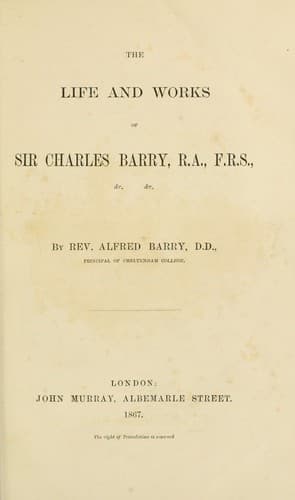
The life and works of Sir Charles BarryBarry, Alfred
General
The life and works of Sir Charles Barry
Barry, Alfred
Architects -- Great Britain -- Biography; Barry, Charles, 1795-1860
From this time the building proceeded quietly towards completion. The
towers were the last finished. There was not, of course, the same
pressure of necessity for their completion; the nature of the soil under
their foundations demanded great care and deliberation in raising the
superstructure; and their design perhaps gave more trouble to the
architect than that of any other part of the building. “Nothing,” it has
been truly said, “tended more to retard a general appreciation of the
architectural merits of the New Palace than the necessarily slow and
protracted realization of its chief vertical features and skyline.” The
central tower was the first finished; next came the clock-tower; and
finally the great mass of the Victoria tower received its last stone.
The great flagstaff rising above was added subsequently. It was indeed
the last object which engaged his professional attention in the
building, and was left unfinished at his death. The drawings of the
flagstaff, and the lantern-work at the base, with its screens and flying
buttresses, were made by his son (E. M. Barry, Esq.) in accordance with
his known intentions. But it was on a temporary wooden staff, that the
great flag was hoisted “half mast high” on the day of Sir Charles’s
funeral.
SECTION IV.--It is impossible in a life of Sir C. Barry to omit notice
of the long, harassing, and unsuccessful controversy, which he carried
on with the Government in relation to his remuneration for the New
Palace at Westminster.
To his friends it is a painful subject; its nature and its effect upon
his feelings and his health they would be glad to forget: but the true
statement of the case is not only due to his memory, but also highly
important, both to the architectural profession and the public. It often
happens (it may probably be so in this case) that a battle lost to the
individual by the influence of special circumstances, and by the use of
overwhelming power against him, may prove to have been virtually won for
those who come after him. It will be my endeavour to admit into the
narrative as little as possible any expressions of mere opinion, and to
tell the story chiefly through the main official documents put out on
both sides, omitting the minuter details of the controversy, and the
disputes on trivial points, which naturally arose from the antagonistic
position produced by its continuance.
Public-domain text, read in full here on John Shaqi.
Reviews
Reviews
No reviews yet
Be the first to share your thoughts on this work.
Elsewhere in the archive
Join the Discussion
Join the discussion
Sign in to leave a comment or review.
Sign InorCreate an account