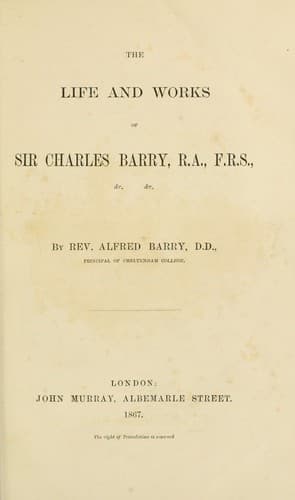
The life and works of Sir Charles BarryBarry, Alfred
General
The life and works of Sir Charles Barry
Barry, Alfred
Architects -- Great Britain -- Biography; Barry, Charles, 1795-1860
The question was briefly this, whether the architect of the New Palace
at Westminster was entitled to the regular professional remuneration of
five per cent. commission upon the outlay on the works executed under
his direction; or whether there were special circumstances in the case,
which justified a departure from the ordinary practice, and the
remuneration of his services on a lower scale. In the course of the
discussion arose another question, hardly less important to the public,
whether the Treasury were justified, by their position and by their view
of the requirements of the public service, in constituting themselves
judges of the question in dispute, in refusing arbitration on doubtful
points, and in enforcing their decision, by withholding all
remuneration, until its principle should be accepted by the architect.
This is no place for discussing at any length the abstract justice and
expediency of the principle of five per cent. commission regularly
recognised by all architects as the method of their professional
remuneration. The principle of a percentage evidently involves some
considerable inequality, when it is applied to works of different
characters, requiring for the same outlay very different degrees of
skill, labour, and responsibility. It seems hard that the architect of a
church, which requires elaborate designs, should be remunerated at the
same rate as the architect, who designs a simple warehouse, or the
engineer who raises great masses of brickwork, requiring but two or
three simple drawings. Like other principles not wholly equitable in
their operation, it is recommended by its simplicity and practicability,
and, in fact, to those who regard their work as a profession, and not a
trade, its commercial inequality is compensated by the corresponding
inequality of artistic opportunities.
But it is certainly not an excessive rate of remuneration. Compared with
the profits of the builders, who execute the work, it is absolutely
insignificant; nor can the remuneration of an architect of eminence bear
comparison with that of an engineer occupying the same position in his
profession. The period over which the expenditure on architectural work
is spread is comparatively large; the preparation of designs and working
drawings, the incessant superintendence, and the duty of “measurement,”
require a large and expensive staff of assistants. It is, therefore,
rare that an architect “makes his fortune,” even if he is engaged in
extensive works, and even if his gross receipts are considerable.
Public-domain text, read in full here on John Shaqi.
Reviews
Reviews
No reviews yet
Be the first to share your thoughts on this work.
Elsewhere in the archive
Join the Discussion
Join the discussion
Sign in to leave a comment or review.
Sign InorCreate an account