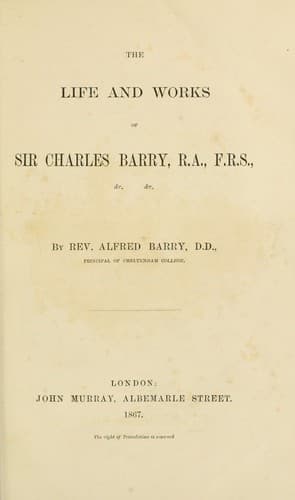
The life and works of Sir Charles BarryBarry, Alfred
General
The life and works of Sir Charles Barry
Barry, Alfred
Architects -- Great Britain -- Biography; Barry, Charles, 1795-1860
So much only is it necessary to remark on the general principle. On the
particular case I must add (what will in all probability be generally
allowed) that a building of a highly ornate and artistic design, carried
out for a public body, whose requirements and instructions varied
greatly from time to time, and requiring constant attendance on official
personages and Parliamentary Committees, was one for which the regular
percentage would be (to say the least) no excessive remuneration. It is
true that the gross outlay was very great, but it was spread over a
period of about twenty years. It absorbed almost the whole of the
architect’s time, and gradually destroyed most of his private practice.
After 1842 that practice, which would naturally have continued to
extend, both in scale and area, began to diminish, and it is likely that
pecuniarily he would have been nearly as well off, if he had been able
to devote himself to private work. There was nothing in the general
features of the case, which could make it right to treat it as an
exceptional one.
It is therefore necessary to inquire into the special circumstances,
which were held by the Government to require a deviation from the
established usage.
The designs and estimates were accepted, and the works commenced on
July 3rd, 1837, without any official communication with the architect on
the subject of remuneration. On March 1st, 1839 (_i. e._ _more than
nineteen months after the commencement of the building_) he received
from the Commissioners of the Woods and Forests (the “Board of Works”) a
copy of a letter from the Treasury, approving of the following
recommendation from the office of Public Works,[86] and ordering it to
be observed in the remuneration of the architect:--
“THE subject of the remuneration to be made to Mr. Barry, as the
architect selected for superintending the erection of the New
Houses of Parliament, having been pressed upon the attention of
this Board, in consequence of the opinions expressed at different
times in both Houses of Parliament against the principle of
remunerating architects by a commission or percentage upon the
amount of their estimates, we beg leave to state to your Lordships,
that in deference to those opinions, we have given the subject our
best and most mature consideration; and that having carefully
considered all the circumstances of this case, the extent and
importance of the building, the nature and description of the
several works, the very large amount of expenditure contemplated in
Mr. Barry’s estimate, and the period within which it is proposed
that such expenditure should be incurred,--we are therefore of
opinion, that the sum of 25,000_l._ will be a fair and liberal
remuneration for the labour and responsibility to be imposed on Mr.
Barry in the superintendence, direction, and completion of the
intended edifice.
Public-domain text, read in full here on John Shaqi.
Reviews
Reviews
No reviews yet
Be the first to share your thoughts on this work.
Elsewhere in the archive
Join the Discussion
Join the discussion
Sign in to leave a comment or review.
Sign InorCreate an account