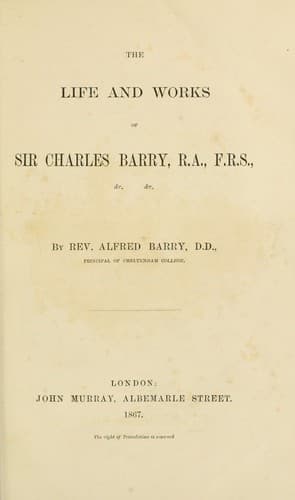
The life and works of Sir Charles BarryBarry, Alfred
General
The life and works of Sir Charles Barry
Barry, Alfred
Architects -- Great Britain -- Biography; Barry, Charles, 1795-1860
It is on the letters of Mr. Barry above referred to, particularly on
that of April 22nd, 1839, that the case of the Government against him
mainly depends. It is clear that his case would have been far stronger,
had he at once ventured to refuse the 25,000_l._ offered him, standing
upon the invariable custom of the profession, and the fact that his
appointment had been made, and the work carried on for more than
nineteen months, before any such conditions were mentioned. On the other
hand, it is equally clear that he was placed in a position of much
difficulty by the action of the Government. He was already thoroughly
absorbed in the work, and had devoted much time and trouble to its
commencement. His success in the competition had excited great and
almost unexampled opposition and misrepresentation; he knew, therefore,
that he had enemies, who would gladly seize any opportunity to produce
a breach between him and the Government, especially on a subject on
which public opinion was at least greatly divided. It appeared to him
very hard that he should be placed in such a position. It was natural
that he should endeavour to take a middle course, and to accept the
terms under a protest, which would leave the matter open for future
consideration. It may be added that the Government, by tacitly receiving
a letter, which contained such a protest, and expressed a hope of such
future reconsideration, must bear some of the responsibility of the
unsettled state in which the question was left, and of the controversy
which accordingly arose.
The whole matter now remained in abeyance for eight years, during which
time the work proceeded. It had been supposed that the building would be
completed in about six years, and at an expense of about 707,000_l._
But, as has been elsewhere shown, from various causes, some wholly
beyond the architect’s control, some for which he was responsible, and
for which the approval of the Government and of Parliamentary Committees
had been obtained, the time occupied in building was greatly protracted,
and the expense proportionately increased. It was conceived by Mr. Barry
and by his friends that the “bargain” made with the Office of Works, if
it had ever had any legal value, had now vitiated by the entire change
of the circumstances on which it was originally based, and that the time
was come when the whole matter must be re-opened. Accordingly he
addressed a letter on February 6th, 1849 to the Commissioners for the
superintendence of the completion of the New Palace, which contains a
full and forcible statement of his case. It will be found in the
Appendix. Its substance must be stated here.
After referring to the fact that he was appointed architect
unconditionally, and that not till nineteen months after his appointment
did he hear of Lord Bessborough’s proposition, he states that, having
vainly asked for an explanation of the grounds of that proposition, he
had acceded to it conditionally and under protest.
Public-domain text, read in full here on John Shaqi.
Reviews
Reviews
No reviews yet
Be the first to share your thoughts on this work.
Elsewhere in the archive
Join the Discussion
Join the discussion
Sign in to leave a comment or review.
Sign InorCreate an account