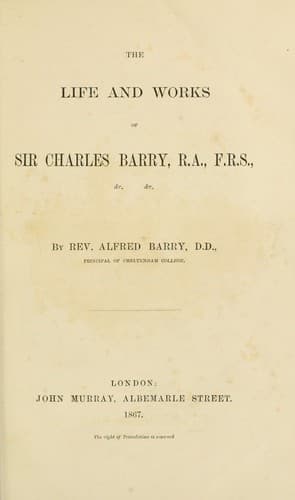
The life and works of Sir Charles BarryBarry, Alfred
General
The life and works of Sir Charles Barry
Barry, Alfred
Architects -- Great Britain -- Biography; Barry, Charles, 1795-1860
He then contends that the bargain as such has been annulled by acts of
the Government, but that he is willing to meet the grounds alleged in
Lord Bessborough’s letter. Accordingly, to the statement of “the extent
and importance of the work,” he answers, that “the responsibilities of
the architect are more than proportionally increased, and the demands on
his skill, taste, and judgment are far greater than in works of less
magnitude.” To the somewhat vague reference to “the nature and
description of the work,” he replies by inviting a comparison between
the New Palace and any other modern building, to show that in “variety
of design, elaboration of details, and difficulties of combination and
construction, the labour and responsibility incurred are greater than in
any modern edifice,” and by referring to official delays and
perplexities, and the control of Parliamentary Committees added to that
of the Government. “It will not be irrelevant to mention (he adds) that
already between 8000 and 9000 original drawings and models have been
made, a large portion from my own hand, and the remainder under my
immediate supervision.” The “statement of the large expenditure
contemplated, and the period in which it was proposed that this
expenditure should be incurred,” he meets by remarking, that “the annual
expenditure has not been greater than that incurred in other public
works on which the full percentage has been paid,” and that from
circumstances over which he had no control, especially the difficulty of
obtaining the whole site, and the introduction of Dr. Reid’s system of
ventilation, the period of the execution of the building had been, and
must be, greatly increased.
He then enumerated extra duties which had been thrown upon him, on which
he might fairly claim remuneration.
He concludes by stating that his appointment had caused the loss of
about two-thirds of his private practice, and declaring that the
ordinary remuneration of five per cent. would be, to say the least, not
more than an adequate return for the “labour, responsibility, and
sacrifices incurred in conducting the largest and most elaborate work of
the period, to which he had devoted almost exclusively the best period
of his professional life.”
Of this letter it would appear that _no notice whatever was taken for
about five years_. On February 8th, 1854, a communication was received
from James Wilson, Esq., in reply to some letter of the same purport
(not printed) from Sir C. Barry to the Chancellor of the Exchequer, and
in accordance with a Treasury Minute on the subject.
Its main points are:--
Public-domain text, read in full here on John Shaqi.
Reviews
Reviews
No reviews yet
Be the first to share your thoughts on this work.
Elsewhere in the archive
Join the Discussion
Join the discussion
Sign in to leave a comment or review.
Sign InorCreate an account