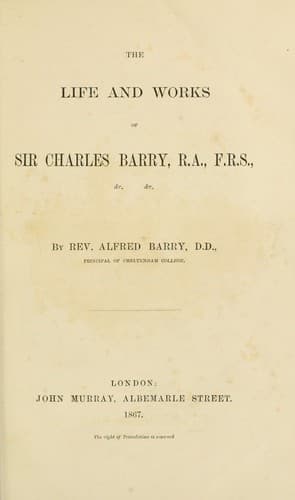
The life and works of Sir Charles BarryBarry, Alfred
General
The life and works of Sir Charles Barry
Barry, Alfred
Architects -- Great Britain -- Biography; Barry, Charles, 1795-1860
(_a._) An assertion that a percentage of three per cent. had been
accepted by Sir J. Soane, Sir R. Smirke, and Mr. John Nash (attached as
architects to the Board of Works), and by Mr. Burton (unattached) for
public works, and an assumption based upon this statement, that the
fixed sum of 25,000_l._ had been calculated by Lord Bessborough as
approximately 3 per cent. on the estimated outlay of 707,104_l._
(_b._) A statement (which it would have been somewhat difficult to
substantiate) that a fixed sum had been “not unfrequently” substituted
for a percentage, in order to “avoid an extension of the works and
consequently of the cost,” such as that to which they advert in respect
of the New Palace.
(_c._) An attempt, afterwards abandoned, to represent Mr. Pugin’s
appointment to superintend the internal fittings as relieving the
architect of labour and responsibility, and accordingly to deduct the
salary (200_l._ a-year) paid to that gentleman, from Sir C. Barry’s
professional remuneration.
(_d._) An offer (which they considered “fair and even liberal”) to allow
three per cent. instead of five on the gross outlay, and to reimburse
the architect for the expenses of measurement. In this offer it will be
observed that they at once relinquish (it may be presumed as untenable)
the principle of the fixed sum, and the bargain made by Lord Bessborough
in 1839.
To this letter, after a delay caused by serious illness, Sir C. Barry
sent on March 14th, 1854, a detailed reply. This reply addresses itself
to each of the three points of Mr. Wilson’s argument, and shows--
(_a._) That the practice of the three per cent. remuneration had been
abolished for seven years before Lord Bessborough’s proposition was
made; that in former times, when the percentage was paid, the architects
were relieved of all measuring and making up accounts, which was done by
the Board; and that since 1832 five per cent. had been paid upon many
important public works, including the British Museum, the National
Gallery, the General Post Office, Windsor Castle, Buckingham Palace, &c.
(_b._) That the increase of expenditure was caused by circumstances not
under the architect’s control, especially by the requirements of Dr.
Reid, and that, as it involved a corresponding increase of labour and
responsibility, it formed no reason for diminution of the rate of
payment.
(_c._) That the post held by Mr. Pugin was not such as to relieve the
architect from responsibility, inasmuch as it was distinctly a
subordinate one.
(_d._) He concludes by reminding the Treasury that mere reimbursement of
expenses by no means meets the claim for measurement, and by urging once
more his right to the customary remuneration.
This letter was so far effectual, that in the correspondence which
follows we hear no more of the precedents for the percentage of three
per cent., or of the deduction of the salary of Mr. Pugin.
Public-domain text, read in full here on John Shaqi.
Reviews
Reviews
No reviews yet
Be the first to share your thoughts on this work.
Elsewhere in the archive
Join the Discussion
Join the discussion
Sign in to leave a comment or review.
Sign InorCreate an account