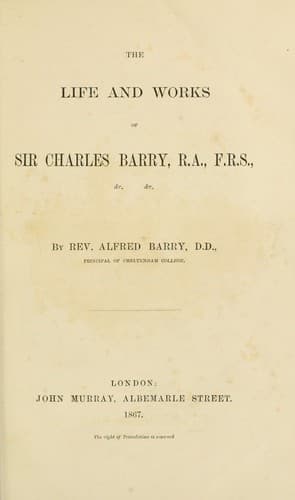
The life and works of Sir Charles BarryBarry, Alfred
General
The life and works of Sir Charles Barry
Barry, Alfred
Architects -- Great Britain -- Biography; Barry, Charles, 1795-1860
“Their Lordships have therefore directed me to transmit to you
herewith the enclosed copy of their Minute of the 4th instant, in
order that you may be informed of the views by which this Board has
been governed in the matter.
“You will learn from that Minute that this Board has not in its
recent correspondence with Sir Charles Barry proposed any new
principle with regard to the professional remuneration of
architects employed on public works, but has, on the contrary,
endeavoured to carry out in a liberal spirit an arrangement, made
in 1838, in consequence of opinions expressed in Parliament, and
acquiesced in by Sir Charles Barry in the following year, as shown
by the correspondence quoted in the inclosed Minute, which took
place in 1838 and 1839, and you will observe that the only
objection then raised by Sir Charles Barry regarded the amount of
remuneration proposed, and not the principle on which it was based.
Their Lordships feel that you might, with greater propriety, call
upon a member of your own body for an explanation of the motives by
which he was governed, rather than address a remonstrance to Her
Majesty’s Government against the deviation, acquiesced in by him in
1839, from the rate of charge recognised by the profession.
“I am, &c.,
(Signed) “JAMES WILSON.”
The correspondence ended with their acknowledgement of this reply,
accompanied by a statement that “it was only after a careful examination
of the whole of the Parliamentary papers connected with the subject,
that the Council arrived at their own conclusions thereon, and framed
and unanimously adopted the resolution in question.”
It was not indeed likely that the Government would allow this
interposition to modify action, which they had formally adopted and
publicly announced. But the interposition itself was very gratifying to
Sir C. Barry, as an acknowledgment that he was fighting the battle of
the profession, and a testimony of the sympathy, which went with him in
a difficult and unequal contest.
It would have been well, if his letter of the 15th had been absolutely
final. But, as was perhaps inevitable, difficulties of detail arose in
carrying out the scheme laid down by the Treasury, and some acrimonious
correspondence was the result. Under the irritation caused by these
petty disputes, the architect once more embodied his views in a formal
protest, which was sent to the Board of Works, and met by a rejoinder
from Mr. H. A. Hunt, their surveyor. Neither the protest nor the
rejoinder add much new matter to the facts of the case, and they need
not be recorded here.
Public-domain text, read in full here on John Shaqi.
Reviews
Reviews
No reviews yet
Be the first to share your thoughts on this work.
Elsewhere in the archive
Join the Discussion
Join the discussion
Sign in to leave a comment or review.
Sign InorCreate an account