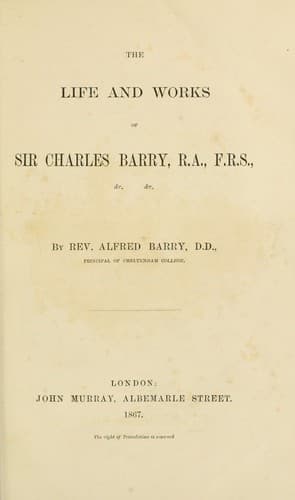
The life and works of Sir Charles BarryBarry, Alfred
General
The life and works of Sir Charles Barry
Barry, Alfred
Architects -- Great Britain -- Biography; Barry, Charles, 1795-1860
One important matter still remains to be noticed. After Sir C. Barry’s
death, his son, Mr. Edward M. Barry, who had long been his assistant in
the work, received from the Board of Works an invitation to undertake
the task of superintendence of “the works at the New Palace at
Westminster, which had received the sanction of this Board, and for
which Parliament had made grants of money,” the rates of his
remuneration to be “the same as those paid to his late lamented father.”
Mr. Barry, of course, rejoiced to have the opportunity of completing his
father’s work, and was willing to accept the rate of remuneration, in
which Sir Charles had already been forced to acquiesce. At the same time
he felt it right to inform the Board of Works that he did so in
consequence of this desire to carry out Sir Charles Barry’s designs;
“otherwise,” he adds, “I should have felt bound, on public grounds, and
in justice both to myself and the architectural profession, to have
called the attention of the Chief Commissioner to the fact that the
remuneration forced upon my father’s acceptance by the Treasury minute
of January 29th, 1856 (against the injustice of which he always
protested) is:--
“1. Less than is customary with architects of standing, and
adequate in the case of the Palace.
“2. Less than has been, and is now, paid to architects employed by
the Government on other works.
“3. Less than was recently offered by the Government to architects
of all nations, in the public competition for the new Government
Offices.”
In November, 1863, in sending in his professional charges, calculated at
the rate of four per cent., Mr. Barry remarked on the extension of the
work beyond the amount which was calculated upon in the first instance,
and for which money had been voted at the time of Sir C. Barry’s death,
and on certain additional duties which had devolved upon him as
architect. At the same time, considering the case as one of an
exceptional character, on which he had already maintained the abstract
principle in his letter of June 8th, 1860, he left the matter entirely
in the hands of the First Commissioner. The result was that in March,
1864, the Office of Works informed him that, by order of the Treasury,
they were ready to “pay a commission of five instead of four per cent.
upon the expenditure for the past and present financial years” (March
31st, 1862-1864). For all subsequent works upon, or connected with, the
New Palace of Westminster, Mr. Barry has received, without question, the
customary remuneration of five per cent. On the bearing of this
proceeding on the question at issue it is hardly needful to remark.
Before collecting in one view the results of the whole controversy,
there is one subject closely connected with it, to which it is necessary
briefly to advert.
Public-domain text, read in full here on John Shaqi.
Reviews
Reviews
No reviews yet
Be the first to share your thoughts on this work.
Elsewhere in the archive
Join the Discussion
Join the discussion
Sign in to leave a comment or review.
Sign InorCreate an account