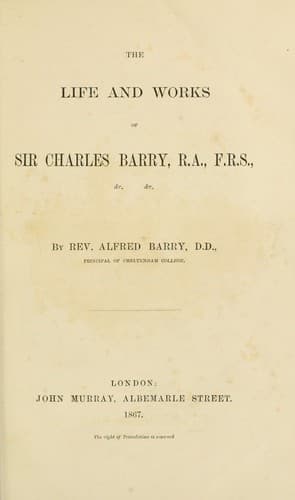
The life and works of Sir Charles BarryBarry, Alfred
General
The life and works of Sir Charles Barry
Barry, Alfred
Architects -- Great Britain -- Biography; Barry, Charles, 1795-1860
I. The attempt to supersede the regular method of professional
remuneration by the offer of a fixed sum for the completion of the work
_was practically abandoned by the Government_. The question between them
and the architect turned on the amount of the percentage (whether it
should be four or five per cent.), a question which made a difference to
him of some 23,000_l._, but which did not settle any great principle, or
materially affect the public interest, in the general question of the
relations of the Government to the architects employed in public works.
II. It cannot be questioned that the Government made use of their power
to enforce an acquiescence in their terms, irrespectively of the
arguments by which they sustained them. This they did (as will be
noticed)--
1. By not unfrequent interpositions of delay.
2. By an attempt (afterwards withdrawn) to construe the acceptance of a
payment on account, due on any supposition, to be an acquiescence in the
principle of their proposal.
3. By ordering all payments whatever to be withheld until the architect
yielded to their terms, and by ignoring all claims for interest, on
payments thus deferred and afterwards acknowledged to be due.
4. By refusing all arbitration, either on the general question or on
that of the “special services.”
III. It is evident that the real ground of their action, and the reason
why that action was allowed to pass almost unquestioned in
Parliament,[89] was the great increase of expenditure on the building,
the delay in its completion, and the unpopularity into which, from these
and from other causes, it had been brought. But for these things, the
whole responsibility for which they were inclined to throw upon the
architect, they would not have ventured, and probably would not have
wished, to deal with him on a principle, which, in no other case (not
even in the completion of the New Palace itself) did they show any
determination to enforce. How far their course can be justified by these
grounds of proceeding, it must be left to others to decide.
Such is the general narrative of the erection of the building. It has
been given at some length, as forming a curious and not unimportant
chapter in the history of modern English architecture. Such critical
notice of it, as is necessary here, must be reserved for the next
chapter.
CHAPTER VII.
THE NEW PALACE AT WESTMINSTER.
Public-domain text, read in full here on John Shaqi.
Reviews
Reviews
No reviews yet
Be the first to share your thoughts on this work.
Elsewhere in the archive
Join the Discussion
Join the discussion
Sign in to leave a comment or review.
Sign InorCreate an account